When I consider marble for an outdoor statue, I start with the installation site—not just the appearance of the stone. A statue in a sheltered courtyard faces different conditions from one beside the sea or in a garden with repeated winter freezing.
Yes, marble can be suitable for outdoor statues, but it is not weatherproof. Its performance depends on the particular stone, the design, local weather, installation, and maintenance. Rain can gradually soften carved details. Freezing water can widen existing cracks. Salt and pollution can create additional problems.
My advice is to treat an outdoor marble statue as a long-term stone installation rather than a decoration that needs no attention. Below, I explain how to judge whether marble fits your climate, what to specify before production, and when another material may be more practical.

What Makes Marble Suitable for Outdoor Statues?
Marble combines natural beauty with the ability to hold finely carved detail. That makes it an appealing choice for classical figures, religious statues, garden sculptures, and architectural features. My recommendation, however, is to separate its artistic advantages from its resistance to outdoor exposure.
For more background on its sculptural qualities, see why marble is used for sculptures.
Natural Stone with Long-Term Durability
Marble is a metamorphic stone: limestone or similar carbonate rock transformed by heat and pressure. It is strong in compression, meaning it can carry substantial loads when properly supported.
Historic marble sculptures show that the material can survive for a very long time. Their survival does not mean the surface remains unchanged, though. Outdoor exposure can cause roughness, discoloration, weakened details, and loss of polish.
I distinguish between two buyer expectations:
- Structural survival: the statue remains stable and intact.
- Surface preservation: the statue keeps its original color, finish, and crisp details.
Marble may satisfy the first expectation while gradually falling short of the second. If you want a permanently pristine appearance, exposed outdoor marble requires careful consideration.
Different Marble Types Have Different Weather Resistance
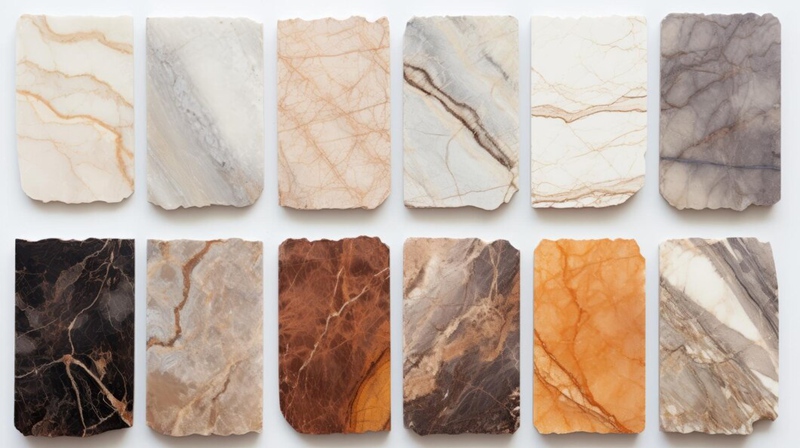
“Marble” is not one uniform material. Stone from different sources—and even different blocks from the same source—can vary in water absorption, mineral composition, cracks, and strength.
I would assess the actual proposed stone rather than select it by color or trade name alone.
| Stone characteristic | What to check | Why it matters outdoors |
|---|---|---|
| Water absorption | Relevant test information for the proposed stone | Absorbed water can contribute to frost and salt damage |
| Veins and fissures | Whether visible lines are sound veins or open weaknesses | Weak areas may affect carving and long-term stability |
| Mineral inclusions | Minerals that may react or discolor | Some inclusions can produce staining when exposed |
| Grain structure | Evidence of suitability for exterior use | Certain marbles can develop a loose, grainy surface |
| Repairs and fillers | Location, purpose, and outdoor suitability | Repairs may weather differently from the surrounding stone |
My practical takeaway is simple: an attractive sample is useful, but it is not proof of outdoor performance. For an overview of available varieties, see how many types of marble there are.
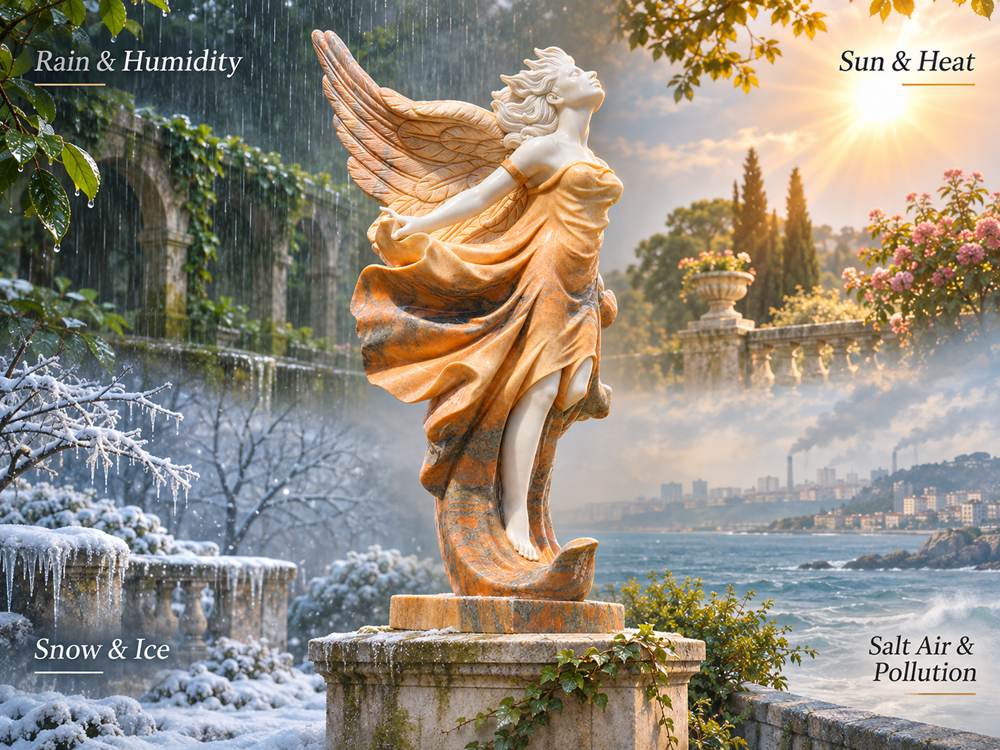
How Different Weather Conditions Affect Outdoor Marble Statues
I find it useful to identify the main damage mechanism before choosing a protection method. A treatment intended to reduce water absorption, for example, does not solve poor drainage or eliminate acid attack.
Rain and High Humidity
Marble contains carbonate minerals that can react with acidic water. Rain is naturally mildly acidic, and air pollution can increase its acidity. Over time, exposed surfaces may lose polish and sharp detail.
High humidity also keeps stone damp for longer. In shaded locations, persistent moisture can encourage algae and other biological growth.
I would pay particular attention to carved recesses, horizontal ledges, and areas beneath trees. These locations can retain moisture, collect debris, and develop uneven staining.
Strong Sunlight and High Temperatures
Marble does not normally fade like a painted surface. However, sunlight and heat still affect an outdoor installation.
Temperature changes cause expansion and contraction. Uneven heating can place stress on vulnerable details, existing cracks, joints, and repairs. Adhesives, fillers, and protective products may also age differently under strong sunlight.
In hot climates, my main concern is usually the complete assembly—not simply the stone’s response to sunlight. The base, fixing system, repair materials, and irrigation exposure all deserve attention.
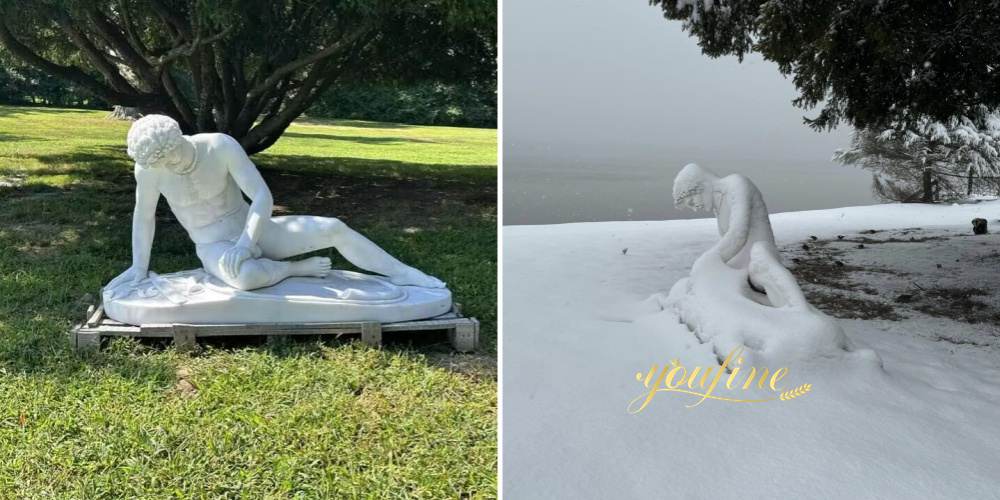
Snow, Ice, and Freeze-Thaw Cycles
Freeze-thaw damage occurs when water enters pores or cracks, freezes, and contributes to deterioration through repeated cycles.
Not every marble statue fails in a cold climate. The risk depends on the stone’s properties, saturation, existing weaknesses, and the frequency of freezing and thawing.
I would avoid designs with deep pockets that hold water in an exposed winter setting. Thin fingers, projecting leaves, and narrow unsupported features also deserve more scrutiny than a compact form.
Coastal Salt Air and Pollution
Salt spray can deposit salts on and within stone. As moisture conditions change, salt crystallization can contribute to surface breakdown. Coastal exposure can also affect metal fixings and cause staining if unsuitable metals are used.
Air pollution creates a different challenge. Deposits can soil the surface, while acidic pollutants contribute to chemical deterioration. Sheltered areas may develop dark crusts rather than weathering evenly.
I would not assume that a sealer makes marble maintenance-free beside the sea.
Is Marble Suitable for Different Climates?
Country names provide only a starting point. Canada includes very different exposure conditions, just as Australia includes coastal, tropical, and dry inland settings.
The examples below are illustrative buying scenarios, not verified customer projects or feedback. I would use them to identify questions for your own site.
| Climate or exposure | Main concern | My purchasing priority |
|---|---|---|
| Cold with repeated freezing | Water entry and frost damage | Stone evidence, drainage, and robust details |
| Rainy and humid | Persistent dampness and surface growth | Drying conditions and accessible cleaning |
| Hot and sunny | Thermal movement and aging of repairs | Compatible materials and reliable anchoring |
| Coastal and tropical | Salt, moisture, and biological growth | Exposure assessment and realistic maintenance |
The most demanding sites often combine several risks. A wet coastal location that also freezes needs more careful evaluation than a sheltered inland garden.
For a broader discussion of service life, see how long marble statues last.
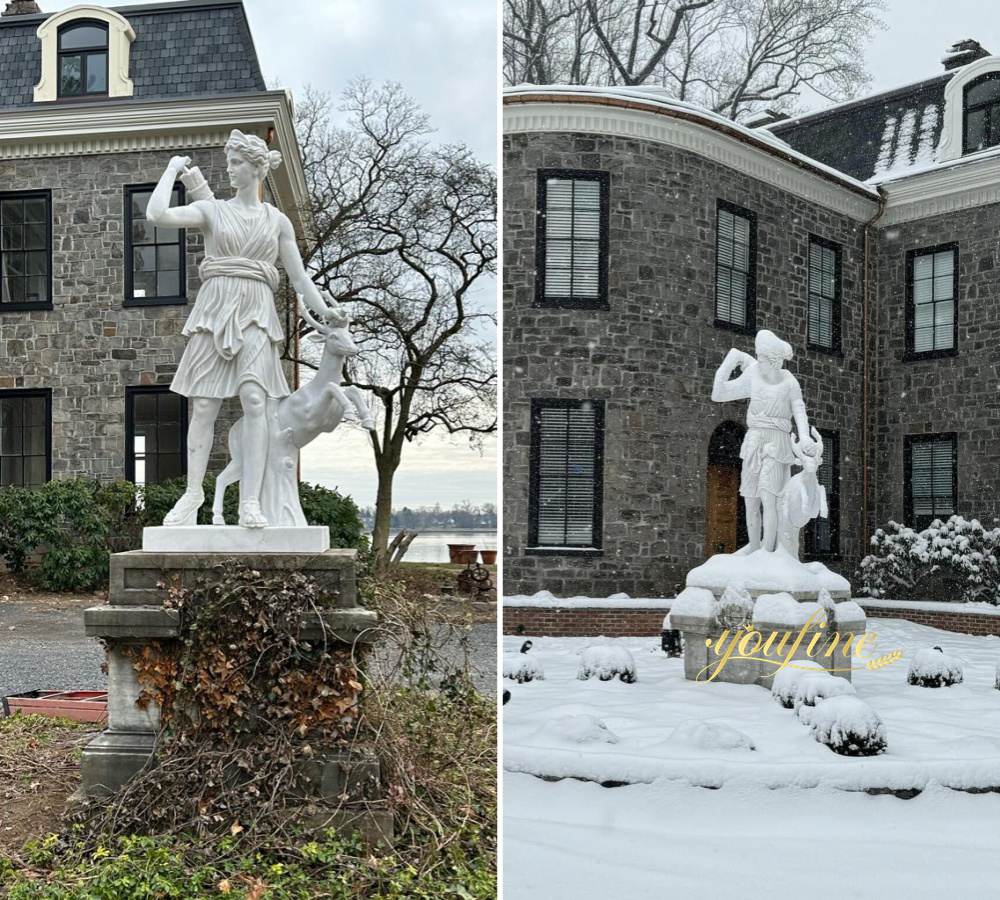
Marble Statues in Cold Climates (Canada, Northern Europe, and Northern USA)
Marble can be considered for cold locations, but I would make frost exposure a purchasing condition from the beginning.
For example, a statue in a northern garden should have a base that sheds water and a design without unnecessary water-trapping cavities. Where the climate is demanding, ask for relevant frost-resistance information for the proposed stone.
A winter cover may help in some situations, but it must not trap condensation. I would seek advice on a ventilated protective arrangement rather than wrap the statue tightly in plastic.
Marble Statues in Rainy and Humid Climates (UK and Western Europe)
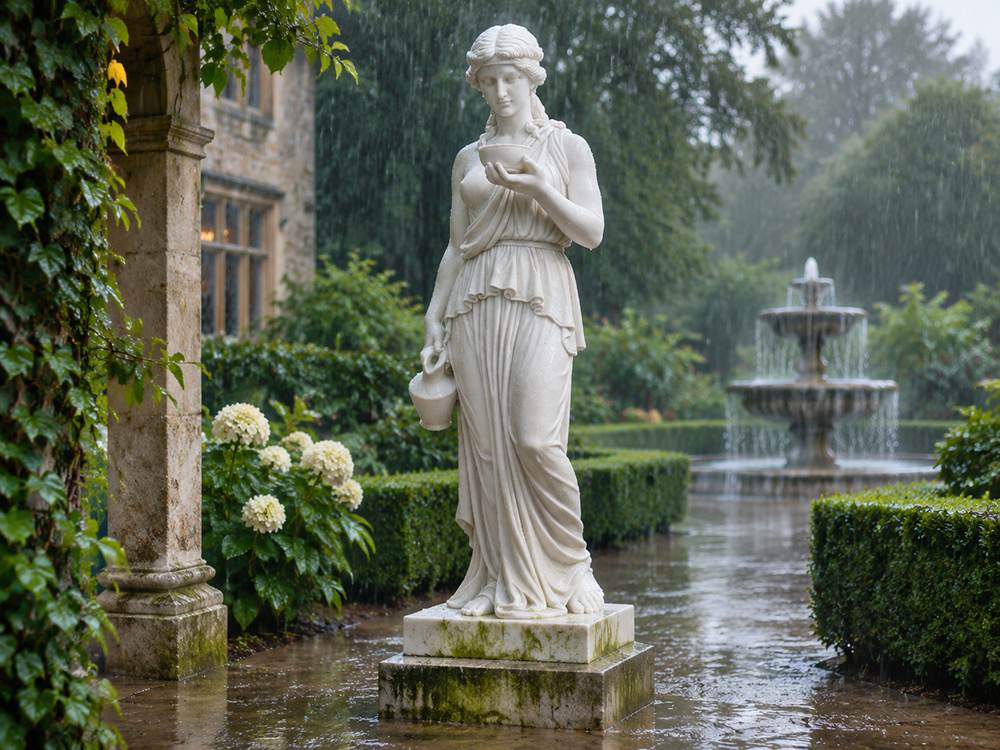
In a frequently wet garden, the ability to dry between rain events matters. Placing a statue beneath dense foliage may reduce direct rainfall but increase dampness, leaf deposits, and biological growth.
For an illustrative courtyard installation, I would favor a raised, drained pedestal with space around the sculpture for airflow and cleaning. I would also accept that the surface may develop a weathered appearance over time.
Marble Statues in Hot and Sunny Climates (Southern USA, Middle East, and Australia)
A dry inland site may present less frost risk, but “hot climate” does not automatically mean low maintenance. Parts of the southern USA are humid, while Australian and Middle Eastern sites may face coastal salt or windblown dust.
For a sunny landscape installation, I would check repair materials, anchoring, and nearby irrigation. Repeated sprinkler contact can leave mineral deposits and keep one part of the statue wetter than the rest.
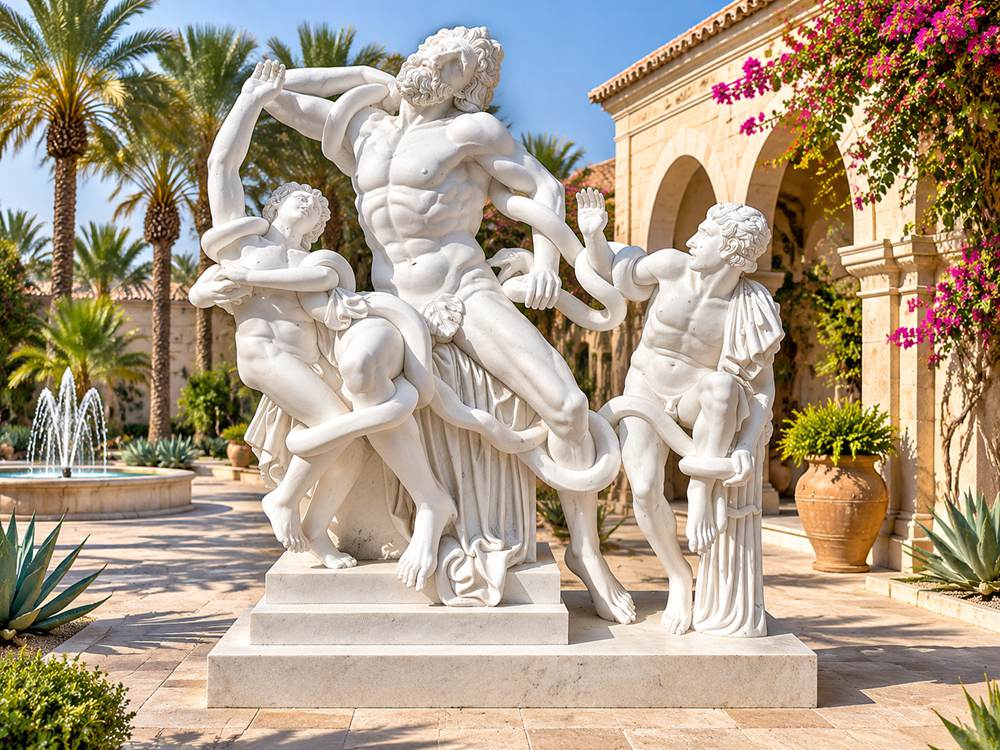
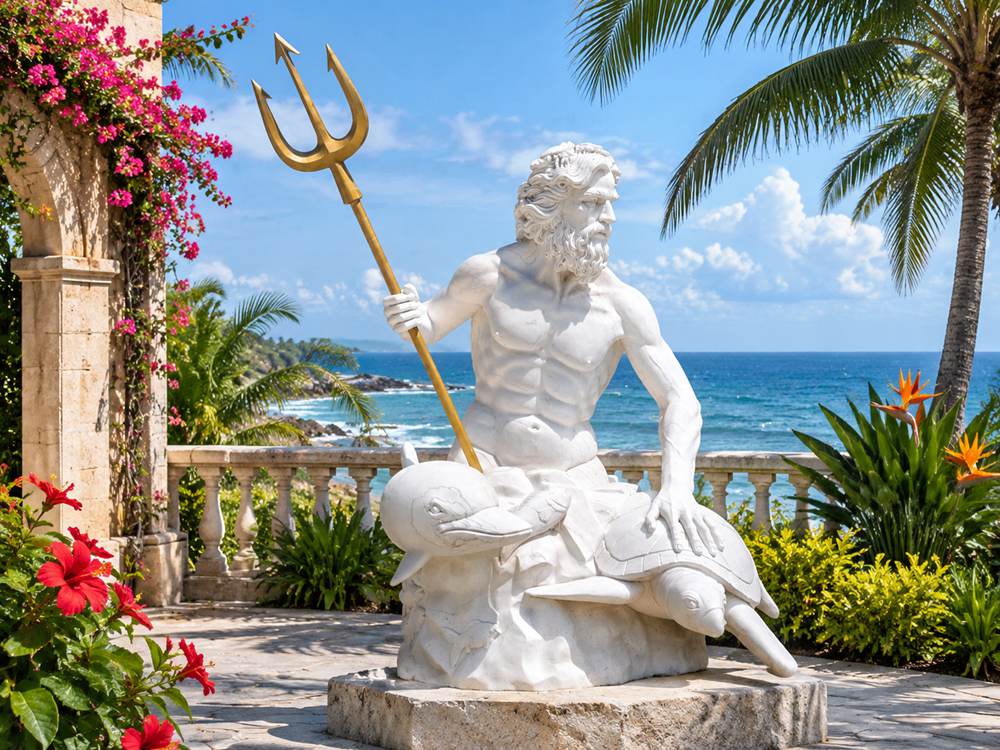
Marble Statues in Coastal and Tropical Climates
Marble requires greater caution where salt spray, heavy rainfall, and persistent humidity occur together.
For a statue close to breaking surf, I would compare marble with alternative materials before approving production. Moving the sculpture farther inland or into a sheltered courtyard may reduce exposure, but it does not remove every risk.
My recommendation is to decide first whether a changing stone surface is acceptable. If not, the material or location may need to change.
How to Protect Marble Statues in Outdoor Environments
Protection begins before carving. I would not rely on a final coating to compensate for unsuitable stone, fragile design, or poor installation.
Choose the Right Marble Before Production
Ask the manufacturer to identify the proposed stone and explain why it suits the intended environment. For larger or higher-risk installations, relevant laboratory testing and independent stone advice may be worthwhile.
My specification checklist would include:
- The exact stone proposed for production.
- Photos showing the block or relevant material condition.
- Disclosure of significant repairs and fillers.
- A design review of thin projections and water-holding areas.
- Agreed surface finish and acceptance criteria.
A sample helps establish color and finish expectations. Natural variation should still be addressed in the purchase agreement.
Use Suitable Stone Protection Products
An impregnating treatment is a product that penetrates the stone to reduce absorption rather than forming a thick surface film. It may help manage water entry or staining when suitable for the marble.
It does not make marble resistant to every acid, prevent all salt damage, or guarantee protection against freezing.
I would compare treatments by their purpose and limitations.
| Treatment | Potential use | Important limitation |
|---|---|---|
| Suitable penetrating water repellent | Reduce liquid-water absorption | Does not eliminate frost or acid-related risks |
| Stain-resistant impregnation | Reduce certain stains | Performance depends on the product and exposure |
| Film-forming coating | Provide a surface barrier | May alter appearance, peel, or impede drying |
| Specialist conservation treatment | Address a diagnosed deterioration problem | Requires expert assessment and compatibility checks |
My preference is to test any proposed product on a small, inconspicuous area and follow its technical instructions. For valuable or historic sculpture, I would involve a qualified stone conservator before treatment.
Ensure Proper Installation and Drainage
A sound installation supports the statue and reduces avoidable water exposure.
I would ask the installer to address foundation stability, pedestal drainage, joint design, and fixing materials. Large statues also need an appropriate assessment of weight, wind exposure, and local site requirements.
The sculpture should not sit in pooled water or rely on an unstable base. Exterior metal fixings must be suitable for the environment and detailed to avoid corrosion-related staining or damage.
Follow a Regular Cleaning and Inspection Schedule
I recommend inspection after severe weather and at intervals suited to the site. Look for new cracks, loose details, staining around fixings, persistent damp areas, and changes at joints.
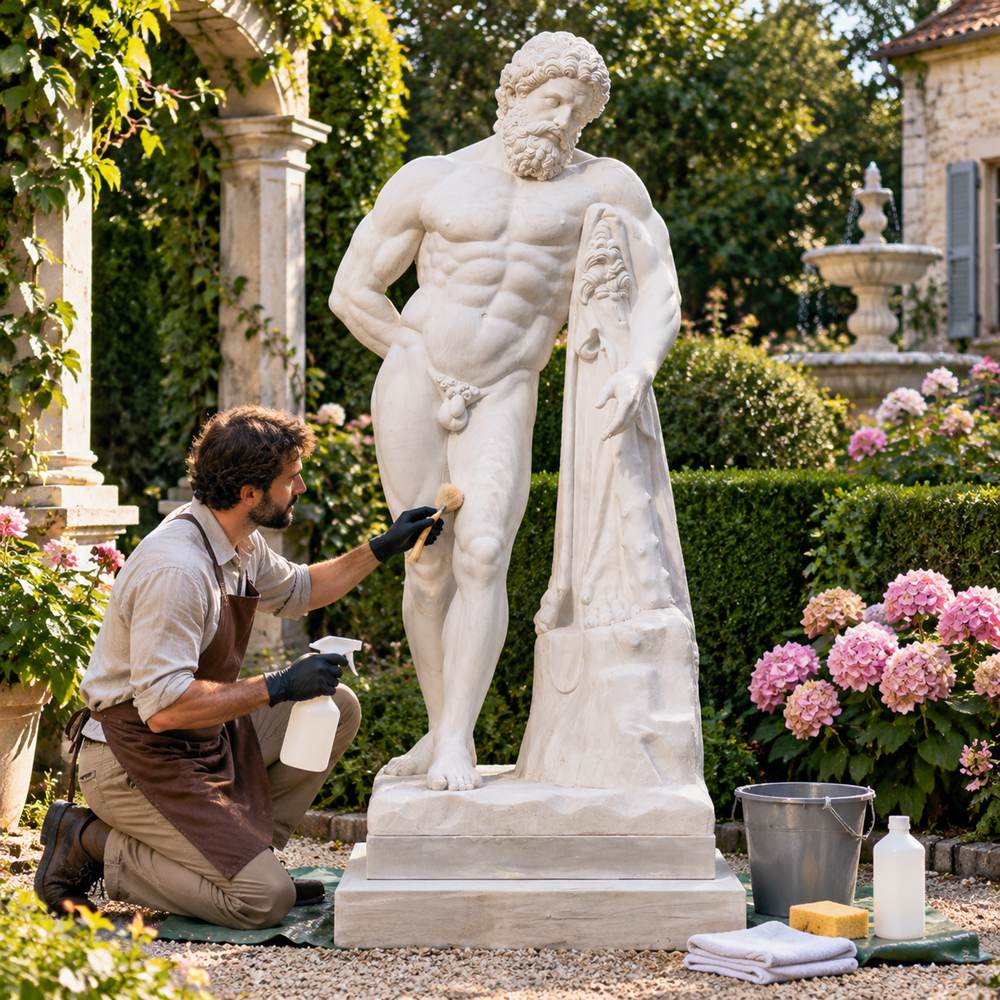
For routine cleaning, begin with gentle methods. Clean water, soft tools, and a suitable pH-neutral stone cleaner are generally safer starting points than aggressive chemicals.
Avoid acidic cleaners such as vinegar. Do not use high-pressure washing as a default method, especially on weathered surfaces or repaired details. If growth, crusts, or stains resist gentle cleaning, I would seek specialist advice rather than increase cleaning force.
Marble vs. Other Materials for Outdoor Statues
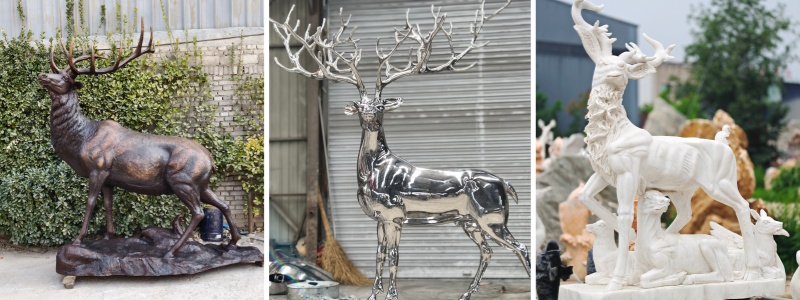
I would choose a material by balancing appearance, exposure, maintenance, and the sculpture’s form—not by asking which material lasts longest in every setting.
| Material | Artistic advantages | Outdoor considerations | Maintenance focus |
|---|---|---|---|
| Marble | Fine carving and a classical natural-stone appearance | Sensitive to acids; frost and salt performance varies | Gentle cleaning, drainage, crack inspection |
| Granite | Durable natural-stone appearance; many types offer low absorption | Properties vary; fine carving may be more demanding | Cleaning and joint inspection |
| Bronze | Suits detailed casting and complex forms | Patina changes; salts and pollution can affect the surface | Suitable cleaning and finish care |
| Stainless steel | Modern appearance and flexible fabricated forms | Grade, weld quality, and exposure matter | Cleaning deposits and checking connections |
| Cast stone | Molded detail and repeatable designs | Quality and frost resistance depend on the formulation | Crack, surface, and moisture inspection |
This comparison does not make every granite frost-proof or every stainless steel sculpture coastal-safe. I would still assess the exact material and manufacturing quality.
Marble remains a strong artistic choice when fine carving and natural stone character are priorities. Another material may be more practical when severe exposure and minimal maintenance are the main requirements.
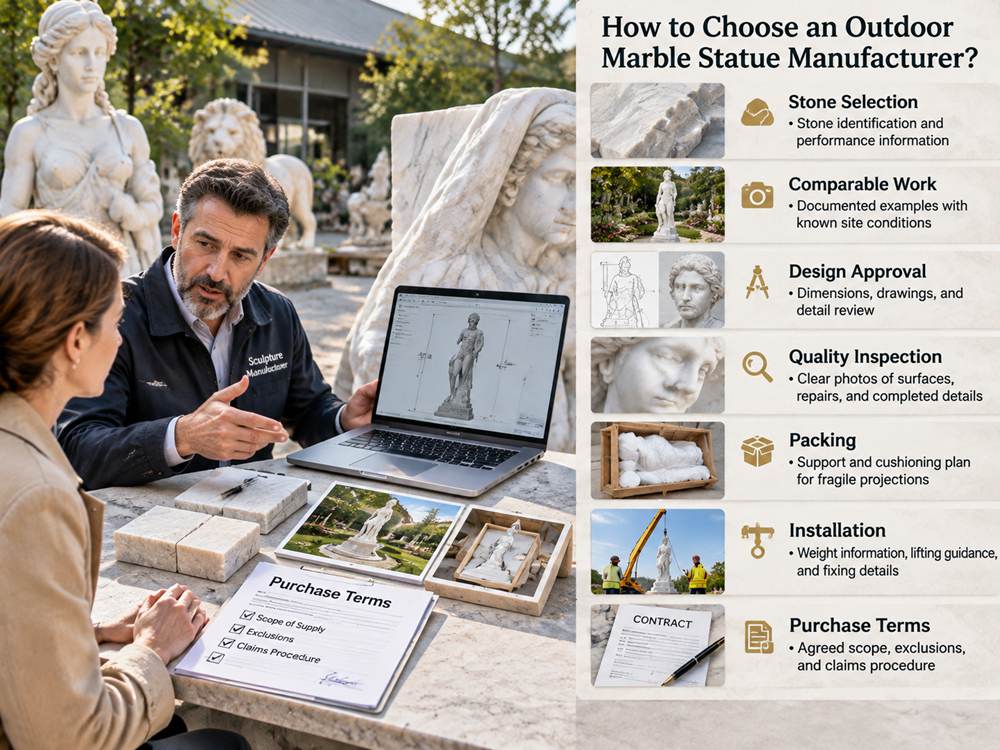
How to Choose an Outdoor Marble Statue Manufacturer?
I would look for a manufacturer who discusses environmental suitability before promising durability. A polished product photograph alone does not establish whether a statue will perform well at your site.
For an international purchase, these are the evidence and documents I would request.
| Evaluation area | What to request | Why it matters |
|---|---|---|
| Stone selection | Stone identification and relevant performance information | Connects material choice to actual exposure |
| Comparable work | Documented examples with known site conditions | Provides more useful context than appearance alone |
| Design approval | Dimensions, drawings, and detail review | Clarifies form, proportions, and vulnerable features |
| Quality inspection | Clear photos of surfaces, repairs, and completed details | Reduces uncertainty before shipment |
| Packing | Support and cushioning plan for fragile projections | Helps prevent transport damage |
| Installation | Weight information, lifting guidance, and fixing details | Supports safe unloading and placement |
| Purchase terms | Agreed scope, exclusions, and claims procedure | Sets clear responsibilities |
If customer feedback is offered, I would ask how long the statue has been installed, where it is located, and what maintenance it receives. A delivery-day photograph says little about weather resistance.
Before shipment, I would also confirm access for unloading, suitable lifting equipment, and responsibility for installation. Protective packing should support the sculpture without transferring loads onto delicate carved features.
My Final Recommendation
Marble can be a suitable outdoor statue material when the stone, design, climate, and installation work together. It is less forgiving where repeated freezing, persistent moisture, salt spray, or pollution are significant.
My recommendation is to approve the complete outdoor specification before approving production. Choose stone with appropriate evidence, reduce water-trapping details, provide stable support and drainage, and plan gentle maintenance. Expect natural weathering rather than a permanently unchanged surface.
Plan Your Outdoor Marble Statue
If you are considering an outdoor marble statue from You Fine Art Sculpture, I suggest starting your inquiry with the site location, approximate size, design references, and local exposure conditions.
Ask for the proposed stone, any available performance information, packing details, and installation requirements. That gives you a clearer basis for deciding whether marble is the right choice before committing to production.
FAQs
1. Can a marble statue stay outside all winter?
It can, provided the stone, design, and installation are suitable for the exposure. I would assess water absorption, existing cracks, drainage, and freeze-thaw conditions before recommending year-round outdoor placement.
2. Does sealing make an outdoor marble statue waterproof?
No. A suitable treatment may reduce absorption, but it does not make the whole statue waterproof or prevent every form of deterioration. I would treat sealing as one part of protection, not a replacement for good design and drainage.
3. Is polished or honed marble better outdoors?
Polished marble is glossy; honed marble has a smoother matte appearance. Both can weather. I would choose based on the intended appearance and maintenance expectations, recognizing that loss of gloss can make weathering especially noticeable on polished surfaces.
4. How much more does outdoor-suitable marble cost?
There is no reliable universal premium. My comparison would include stone selection, testing, design changes, repair restrictions, packing, and installation—not just the carving price. The supplier should explain these items in a project-specific quotation.
5. What should I send a manufacturer for a climate suitability review?
I would provide the installation location, dimensions, design references, pedestal details, and exposure information. Include freezing conditions, proximity to the sea, shade, irrigation, and the level of maintenance you can realistically provide.