In my 20 years of working with bronze fountains for customers around the world, I have found that the most important question is not simply how much a bronze fountain costs, but how much it takes to complete the entire project.
As a general reference, custom bronze fountains typically cost between $5,000 and $50,000+, depending on their size, sculptural complexity, bronze weight, and design requirements. Smaller decorative bronze fountains may fall near the lower end of this range, while large multi-tier fountains with detailed sculpted figures, custom basins, and integrated water systems can require a significantly larger investment.
It is also important to distinguish between the price of the bronze fountain itself and the total installed project cost. A compact bronze feature placed in an existing basin is very different from a large fountain that requires a new pool, concealed pump room, plumbing, and on-site installation.
In this guide, I will explain the main factors that influence bronze fountain prices, the additional costs buyers should consider, and the information needed to obtain an accurate quotation for your project.

How Much Does a Bronze Fountain Typically Cost?
When a customer asks me for a typical bronze fountain price, I first clarify what the purchase includes. Is it the bronze sculpture only, a fountain with water fittings, or a complete installation with a basin and equipment?
Without that distinction, even a seemingly clear price range can be misleading. I would rather provide a project-specific quotation than suggest an unsupported dollar range.
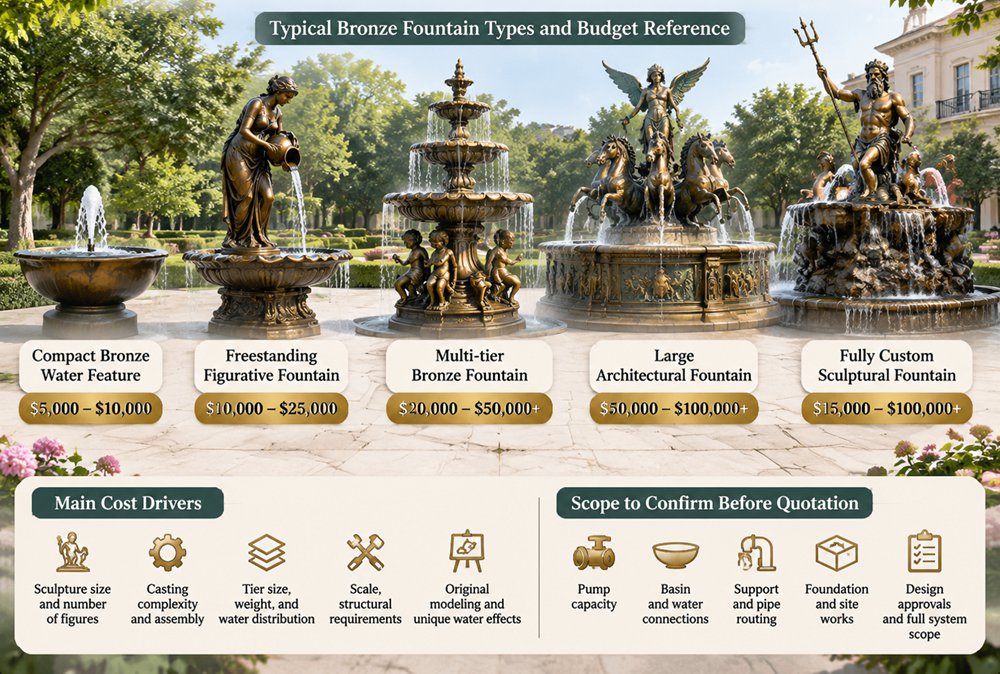
For early planning, I use the following budget categories to separate common fountain types.
| Fountain Type | Estimated Price Range (USD) | Relative Budget Level | Main Cost Drivers | Scope to Confirm |
|---|---|---|---|---|
| Compact bronze water feature | $5,000–$10,000 | Lower within the bronze category | Sculpture size, casting complexity, finish | Pump, basin, and water connections |
| Freestanding figurative fountain | $10,000–$25,000 | Moderate to higher | Number of figures, sculptural detail, assembly | Support, pipe routing, and basin |
| Multi-tier bronze fountain | $20,000–$50,000+ | Higher | Tier size, weight, alignment, water distribution | Pump capacity and supporting foundation |
| Large architectural fountain | $50,000–$100,000+ | High and project-specific | Scale, structural requirements, transport | Engineering, lifting, and site works |
| Fully custom sculptural fountain | $15,000–$100,000+ | Highly variable | Original modeling, detail, revisions, unique water effects | Design approvals and complete system scope |
These categories show the likely direction of cost, not a fixed price ladder. A small, highly detailed custom fountain can cost more than a larger design with simpler forms.
Compare Three Different Totals
I recommend asking for three clearly separated figures:
- Supply price: The bronze fountain and any specifically included components.
- Delivered cost: Supply price plus packing, transport, insurance, and applicable import charges.
- Installed project cost: Delivered cost plus site preparation, lifting, plumbing, electrical work, and commissioning.
Commissioning means testing and adjusting the fountain so that the pump, water flow, drainage, and controls work together.
My main advice is simple: compare quotations at the same level. A sculpture-only price should not be compared directly with a complete installed fountain proposal.
What Factors Affect the Cost of a Bronze Fountain?
Bronze weight matters, but it is only one part of the calculation. I also look at the work required to turn a design into a durable sculpture with a reliable water effect.
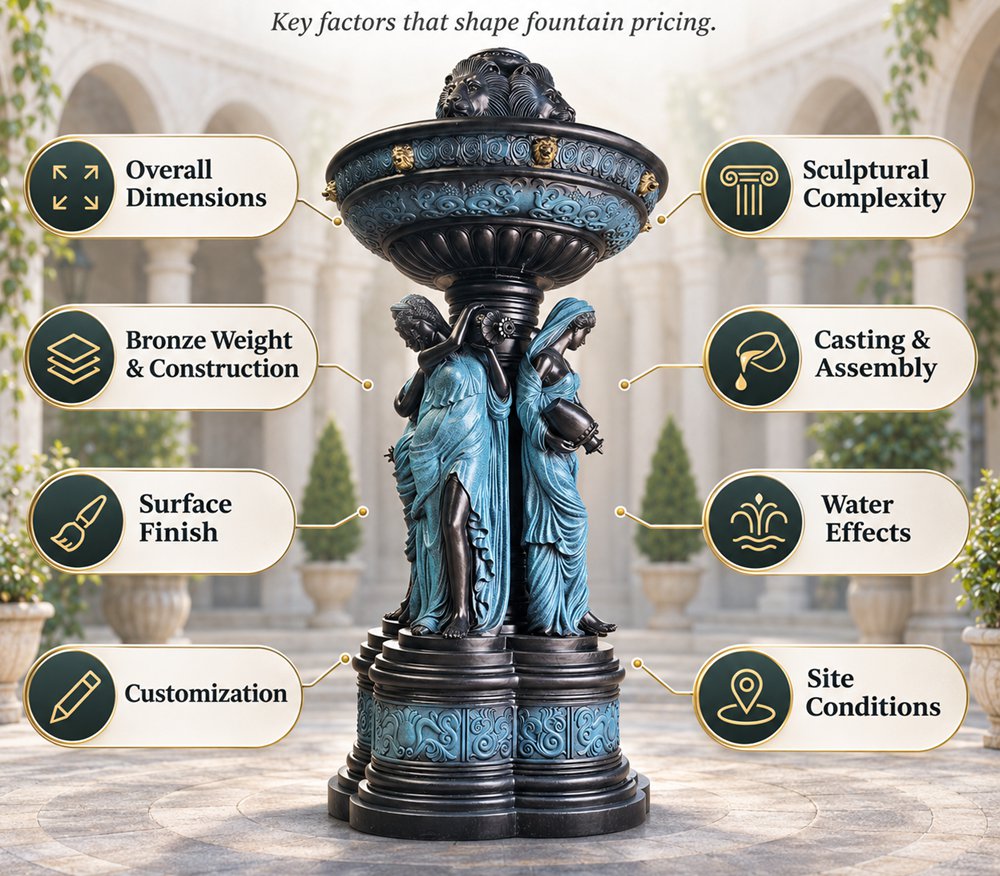
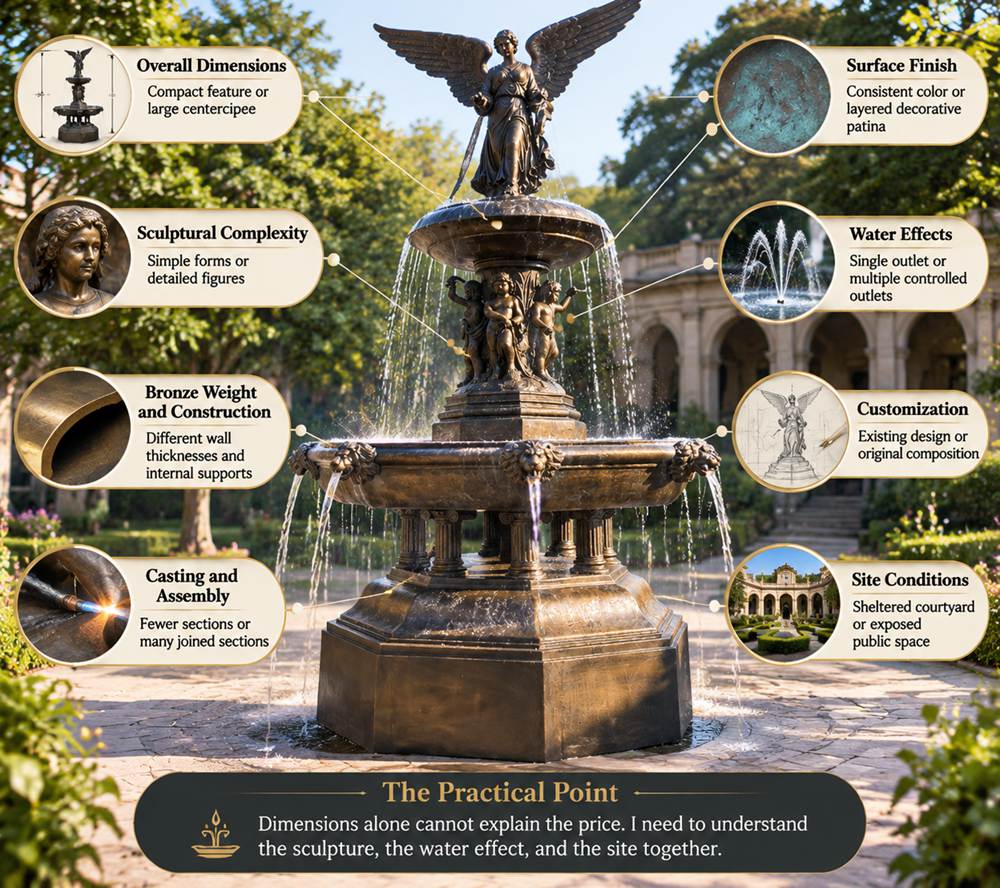
Here are the factors I would review before discussing a budget.
| Factor | Typical Options or Conditions | Why It Matters |
|---|---|---|
| Overall dimensions | Compact feature or large centerpiece | Affects material, handling, packing, and transport |
| Sculptural complexity | Simple forms or detailed figures | Changes modeling, mold-making, and finishing work |
| Bronze weight and construction | Different wall thicknesses and internal supports | Influences material use and structural needs |
| Casting and assembly | Fewer sections or many joined sections | Affects production work and joint finishing |
| Surface finish | Consistent color or layered decorative patina | Changes finishing steps and approval requirements |
| Water effects | Single outlet or multiple controlled outlets | Affects plumbing, pump selection, and testing |
| Customization | Existing design or original composition | Changes design work, approvals, and production planning |
| Site conditions | Sheltered courtyard or exposed public space | Influences drainage, splash control, and installation |
The practical point is that dimensions alone cannot explain the price. I need to understand the sculpture, the water effect, and the site together.
Size, Weight, and Sculptural Detail
A larger fountain generally needs more material and more demanding handling. However, a design with many small figures, intricate textures, or difficult-to-reach surfaces may require considerable work even at a modest size.
Bronze sculptures are commonly hollow castings rather than solid metal throughout. I would therefore ask for the proposed construction and finished weight instead of estimating weight from photographs.
Casting Quality and Finishing
Casting is the process of forming metal in a mold. Lost-wax casting, commonly used for detailed bronze sculpture, uses a wax model that is removed before molten metal fills the mold.
The quality of the finished piece also depends on what happens after casting. Sections may need joining, welds need finishing, and surface details need refinement.
I recommend reviewing close-up production photographs, especially around joints, faces, hands, tier edges, and water outlets. A distant image can hide details that become obvious after installation.
Patina and Water Performance
A patina is a surface color treatment applied to bronze. Natural exposure can also change the surface over time.
I would approve the intended finish through a sample or clear reference rather than relying on a color name alone. Water chemistry, outdoor exposure, and cleaning can affect its appearance.
Water performance deserves equal attention. Multiple outlets, broad cascades, and precise streams can require more coordination than a simple flow from one spout.
What Additional Costs Should You Consider When Buying a Bronze Fountain?
For an international purchase, I encourage customers to build a separate site-and-delivery budget. The bronze artwork may be ready to ship while the basin, foundation, or electrical supply still needs work.
This table identifies expenses I would check before confirming an order.
| Additional Cost | What to Clarify | Who Should Confirm It |
|---|---|---|
| Pump and filtration | Included equipment, operating requirements, service access | Supplier and fountain contractor |
| Basin and waterproofing | Existing basin suitability or new construction | Local contractor |
| Foundation and anchoring | Support loads, fixing method, installation drawings | Qualified local engineer or installer |
| Plumbing and electrical work | Pipe routes, drainage, power supply, controls | Licensed local trades |
| Export packing and freight | Crate dimensions, shipment scope, destination charges | Supplier and freight provider |
| Import charges | Duties, taxes, clearance, documentation | Customs broker |
| Unloading and lifting | Site access, lifting equipment, handling plan | Delivery and installation teams |
| Maintenance | Cleaning, water treatment, surface care, winter shutdown | Owner and maintenance provider |
I would mark each item as included, excluded, or not yet confirmed. That simple exercise often makes a quotation much easier to understand.
Shipping Is More Than the Freight Charge
The transport cost depends on the packed fountain, not just its visible dimensions. Crates, protective supports, and separate components can change the shipment size.
I recommend confirming the delivery term in writing. Incoterms are standardized trade terms that define responsibilities for transport, costs, and certain risks. The quotation should also identify the named delivery location.
Ask whether the price includes destination handling, customs clearance, final delivery, and unloading. These are not automatically part of an international freight quotation.
Installation and Seasonal Operation
Before ordering, I would have a local installer review the proposed fountain location. Important questions include whether lifting equipment can reach the site and whether underground pipes can be accessed later.
In freezing climates, the design needs a suitable drainage and winter shutdown plan. Leaving trapped water in vulnerable components can cause damage. I recommend confirming seasonal procedures before installation, not after the first cold season.
Bronze Fountain vs. Other Fountain Materials
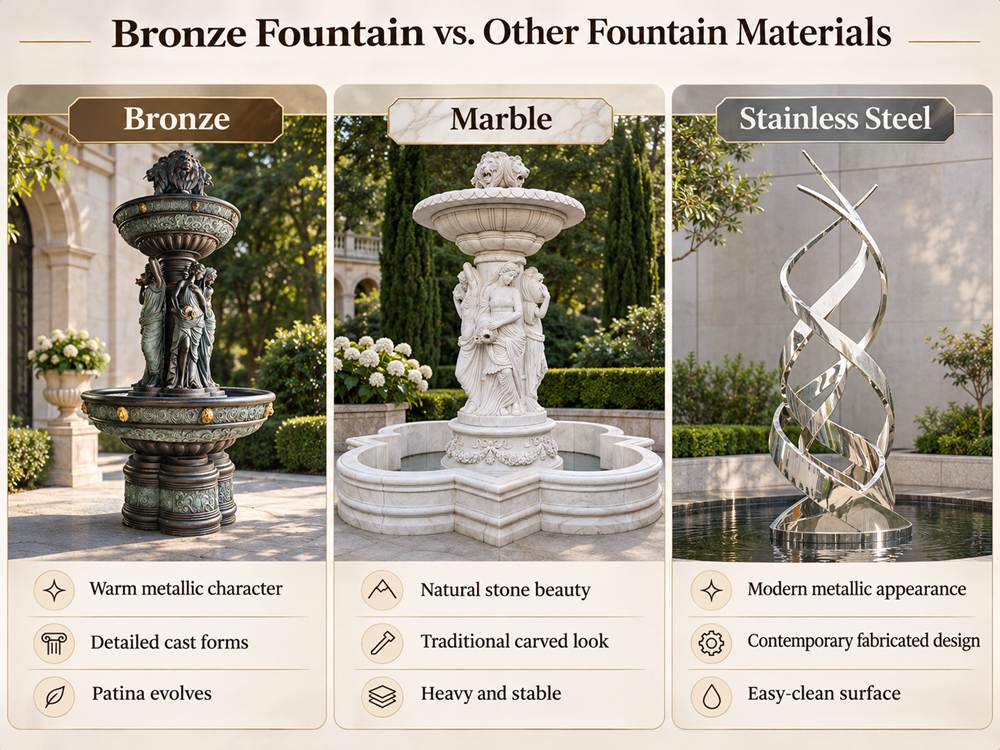
When a buyer is comparing bronze, marble, and stainless steel, I do not judge the options by material price alone. I consider the desired appearance, water exposure, maintenance expectations, and installation conditions.
Here is how I would frame that comparison.
| Decision Factor | Bronze | Marble | Stainless Steel |
|---|---|---|---|
| Visual character | Warm metallic surface; strong fit for figurative work | Natural stone color and veining | Contemporary metallic appearance |
| Design strengths | Detailed figures and sculptural compositions | Carved forms, bowls, and traditional architecture | Geometric forms and fabricated designs |
| Cost drivers | Casting, bronze weight, detail, patina | Stone selection, carving, weight, assembly | Metal grade, fabrication, welding, finish |
| Surface changes | Patina can evolve with exposure | Mineral deposits, staining, and weathering may affect appearance | Water spots and deposits can remain visible |
| Key maintenance concern | Water quality and finish-compatible cleaning | Stone-safe cleaning and site suitability | Appropriate grade and careful surface cleaning |
| Installation concern | Weight, anchoring, joints, water connections | Heavy components and stable support | Fabrication, anchoring, finish protection |
| Best reason to choose it | Preference for cast bronze character | Preference for natural carved stone | Preference for a modern metal aesthetic |
I would not claim that one material is always the cheapest or easiest to maintain. A simple design in one material may cost less than an elaborate design in another.
For bronze, I would discuss the expected patina and care routine. For marble, I would check the stone’s suitability for the local climate and water conditions. For stainless steel, I would confirm the grade and finish against the environment, especially near coastal exposure.
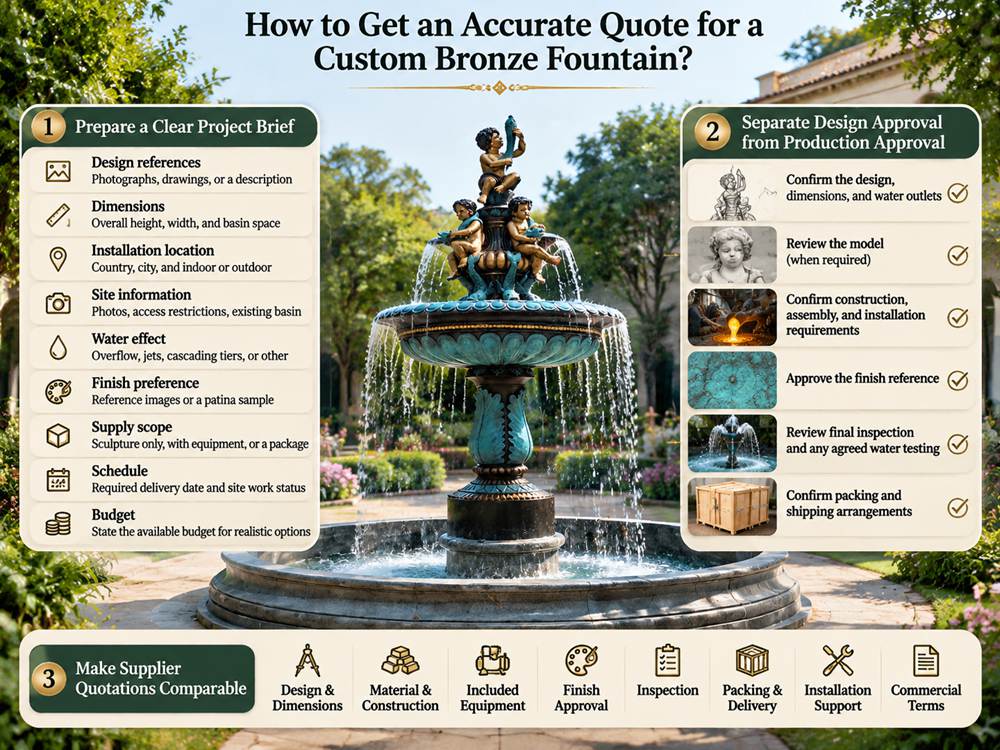
How to Get an Accurate Quote for a Custom Bronze Fountain?
The fastest way to get a useful quotation is to send a clear project brief. I do not need every detail finalized at the beginning, but I do need enough information to distinguish an early estimate from a production-ready price.
Information I Recommend Preparing
- Design references: Photographs, drawings, or a description of the intended composition.
- Dimensions: Overall height, width, and available basin space.
- Installation location: Country, city, and indoor or outdoor setting.
- Site information: Photographs, access restrictions, and existing basin details.
- Water effect: Gentle overflow, individual jets, cascading tiers, or another defined effect.
- Finish preference: Reference images or a requested patina sample.
- Supply scope: Sculpture only, sculpture with equipment, or a broader coordinated package.
- Schedule: Required delivery date and whether site works are already planned.
I recommend stating the available budget as well. That allows the design discussion to focus on realistic priorities rather than unnecessary detail.
Separate Design Approval from Production Approval
For a custom fountain, I would organize approvals around clear stages:
- Confirm the design, dimensions, and water outlets.
- Review the model where one is required.
- Confirm construction, assembly, and installation requirements.
- Approve the finish reference.
- Review final inspection and any agreed water testing.
- Confirm packing and shipping arrangements.
A model is a physical or digital representation used to check the sculpture before casting. Major changes become harder to manage after production progresses, so I recommend settling proportions and composition early.
Make Supplier Quotations Comparable
When reviewing offers, I would use the same checklist for each supplier.
| Quotation Item | What I Would Look For |
|---|---|
| Design and dimensions | Clear identification of the quoted fountain |
| Material and construction | Written bronze and assembly details |
| Included equipment | Named components and stated exclusions |
| Finish approval | A defined reference and approval method |
| Inspection | Agreed photographs, checks, and testing scope |
| Packing and delivery | Packing method, delivery term, named destination |
| Installation support | Drawings and instructions appropriate to the project |
| Commercial terms | Payment stages, change handling, and written warranty terms |
A lower quotation is only meaningful when the scope and quality requirements are comparable. I would resolve unclear exclusions before choosing a supplier.
Why Choose YouFine for Bronze Fountains?
For customers considering You Fine Art Sculpture, I believe the strongest reason to start a discussion is the practical guidance I can offer from 20 years of supplying bronze fountains to customers around the world.
My focus is on helping you define the purchase clearly: the sculpture, the water effect, the delivery responsibilities, and the installation requirements.
I also encourage buyers to evaluate the actual proposal rather than rely on a business name alone. Ask for relevant product images, construction details, finish references, and written commercial terms. Any claim about production capability, testing, or after-sales coverage should be supported by information specific to the order.
For me, a useful quotation is one that helps you make a confident decision—not simply one that shows an attractive starting price.
FAQs
1. Can I get a bronze fountain price from a photograph?
I can use a photograph to begin a design and budget discussion, but it is not enough for a firm quotation. Dimensions, construction, finish, water effects, and delivery scope still need confirmation.
2. Does a bronze fountain quotation include the pump and basin?
Not necessarily. I recommend checking the itemized scope. The bronze sculpture, pump, filtration, basin, and installation may be quoted separately.
3. Is a custom bronze fountain always more expensive than an existing design?
Not always, although original modeling and additional approvals can increase the cost. I would compare the complete specifications: a simple custom design may require less work than a complex existing fountain.
4. How long does a custom bronze fountain take to produce?
I would confirm the schedule after reviewing the design and approval stages. Modeling, casting, finishing, testing, and transport all affect timing; a production estimate should not be treated as an arrival date.
5. Can a bronze fountain be installed outdoors in a cold climate?
Yes, provided the complete system is designed for the conditions. I recommend confirming drainage, winter shutdown procedures, foundation requirements, and suitable care instructions with the supplier and local installer.

Final Thoughts: Budget for the Complete Fountain
The cost of a bronze fountain is best understood as a complete project, not an isolated sculpture price.
My recommendation is to begin with the design and site, confirm the water-system scope, and then separate supply, delivery, and installation costs. That approach makes supplier comparisons clearer and reduces the risk of unexpected expenses.
If you are considering a bronze fountain from You Fine Art Sculpture, send me your reference images, preferred dimensions, installation location, and target schedule. I can use that information to help clarify the design and quotation scope so you can plan the project with greater confidence.