My first priority when cleaning a mirror-polished stainless steel sculpture is to protect the reflection—not simply remove the dirt. A surface can look clean and still develop fine scratches if a cloth drags dust across it or a cleaner contains abrasive particles.1
The safest approach is usually straightforward: remove loose debris, wash gently with a mild solution, rinse thoroughly, and dry with a clean, soft cloth. The details matter, especially on outdoor sculptures exposed to grit, bird droppings, and mineral-rich water.
In this guide, I explain how to clean the surface, treat common stains, and plan long-term maintenance.
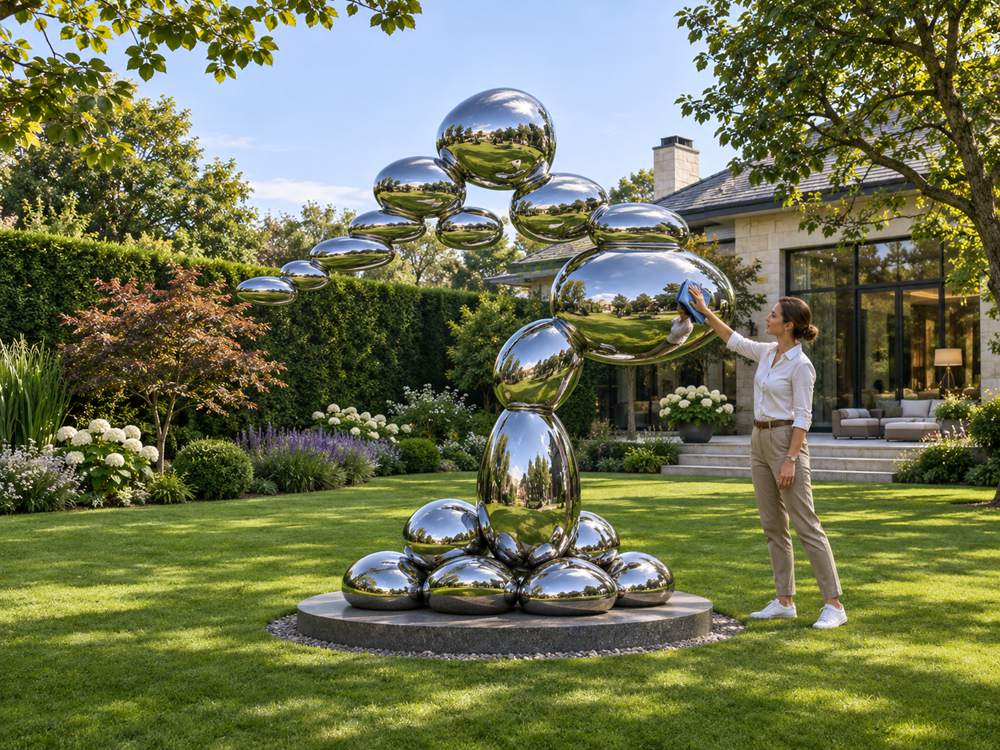
Why Mirror-Polished Stainless Steel Sculptures Need Special Care
Mirror polishing produces a highly reflective surface by progressively smoothing the metal.2 Unlike a brushed finish, which has a visible directional texture, a mirror finish reflects its surroundings clearly. Fine scratches can interrupt that reflection and become noticeable under direct light.
Stainless steel also has a thin protective oxide layer that helps resist corrosion3. However, “stainless” does not mean scratchproof or immune to corrosion. Salt deposits, unsuitable chemicals, and contamination can still cause problems.
I separate surface care into three priorities:
- Prevent abrasion: Remove grit before touching the surface with a cloth.
- Avoid chemical damage: Use a cleaner suitable for the actual finish, including any protective coating.
- Prevent residue buildup: Rinse away soap and dry before water leaves mineral deposits.
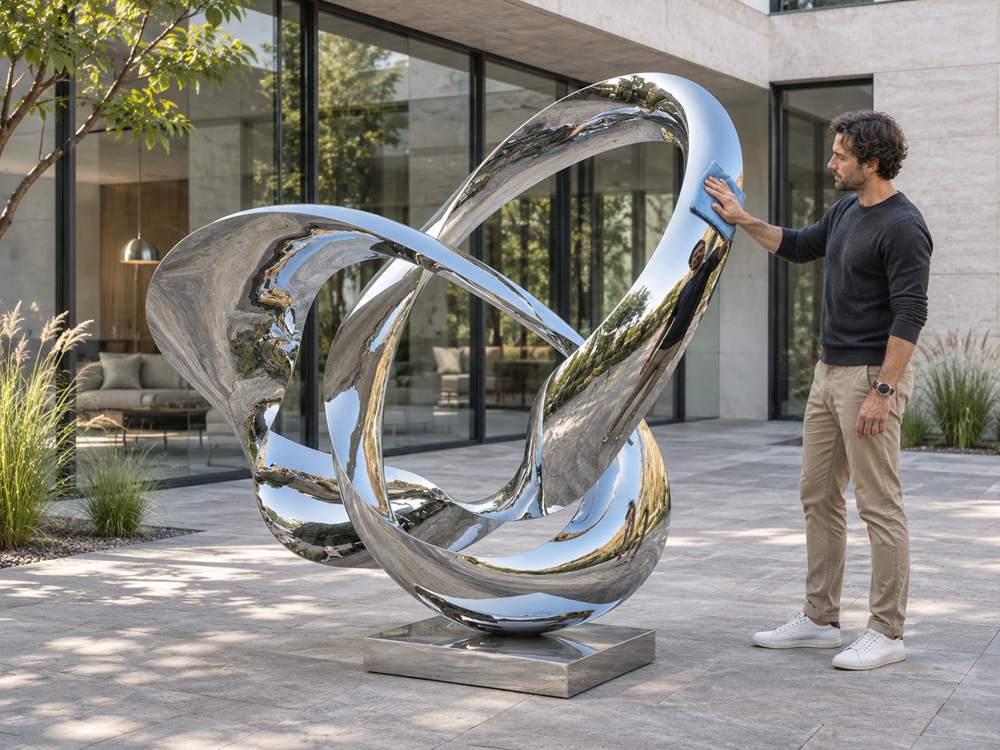
Before starting, I would confirm whether the sculpture is bare mirror-polished stainless steel or has a clear coating, tinted treatment, or other surface protection. A cleaner suitable for bare stainless steel may not be suitable for a coating.
What You Need to Clean a Mirror-Polished Stainless Steel Sculpture
I recommend preparing everything before cleaning so the wet surface does not sit unattended while you search for another cloth.
| Item | What to Choose | Purpose |
|---|---|---|
| Cleaning cloths | Clean, soft, lint-free microfiber cloths | Gentle washing and drying |
| Cleaning solution | Mild, non-abrasive, pH-neutral detergent approved for the finish | Remove ordinary dirt and light grease |
| Water | Clean water; distilled or deionized water for the final rinse where practical | Reduce residue and water spotting |
| Containers | Clean buckets or spray bottles | Keep the solution free from grit |
| Hand protection | Clean gloves suitable for the cleaner | Protect hands and limit fingerprints |
| Outdoor rinsing equipment | A hose with a gentle flow | Flush away loose dirt |
| Inspection light | Soft daylight or a movable light | Identify marks without repeated rubbing |
A clean cloth matters as much as its material. I would not reuse a microfiber cloth that has cleaned a floor, handled metal dust, or fallen onto the ground.
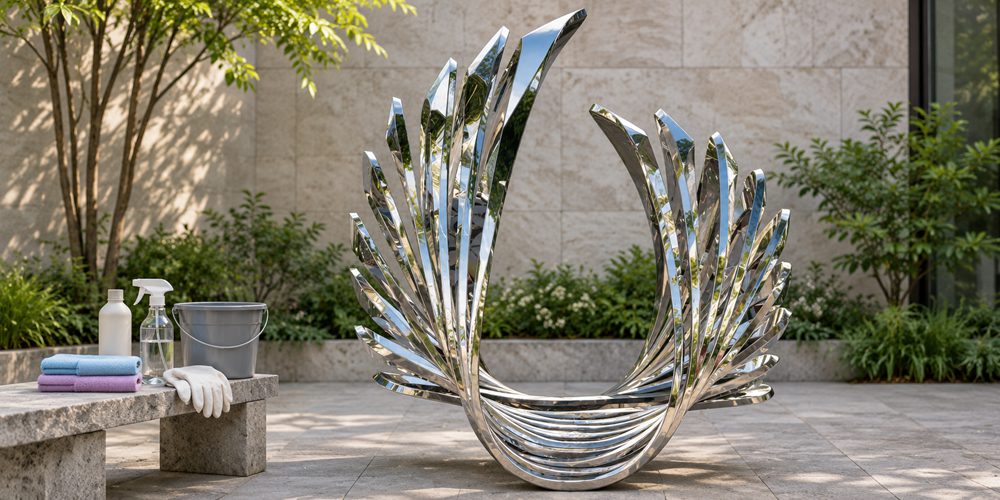
A clean cloth matters as much as its material. I would not reuse a microfiber cloth that has cleaned a floor, handled metal dust, or fallen onto the ground.
Keep washing and drying cloths separate. If a cloth picks up grit, replace it immediately rather than folding the contaminated area inward and continuing.
For large sculptures, plan safe access first. I would arrange professional help for surfaces that require climbing, lifting equipment, or working close to roads or water.
Step-by-Step: How to Clean a Mirror-Polished Stainless Steel Sculpture
Before cleaning the whole sculpture, I recommend testing the method on a small, inconspicuous area. Follow the supplier’s care instructions if they specify a different procedure.
Choose a cool surface out of direct sunlight. Heat can dry the solution before it is rinsed away, leaving streaks or concentrated residue.
Step 1: Remove Loose Dust and Surface Debris
Do not begin by wiping a dusty surface.
For outdoor sculptures, gently rinse from the top downward with clean water. Let the water carry away sand and loose particles. Avoid directing water into openings, electrical components, or joints not designed to receive it.
For an indoor sculpture that cannot be rinsed, I would use a clean hand-operated air blower to remove loose dust, followed by carefully dampening remaining particles before lifting them away.
If grit remains attached, soak it gently. Do not press harder.
Step 2: Prepare a Gentle Cleaning Solution
Mix a mild, pH-neutral detergent with clean water according to its instructions. Use only enough detergent to clean effectively; excess soap means more rinsing.
I would check the product label for abrasives, bleach, or strong acidic or alkaline ingredients. A cleaner labeled “for stainless steel” is not automatically suitable for a decorative mirror finish.
Apply the solution to a cloth or a small working area rather than spraying the entire sculpture at once.
Step 3: Gently Wipe the Surface
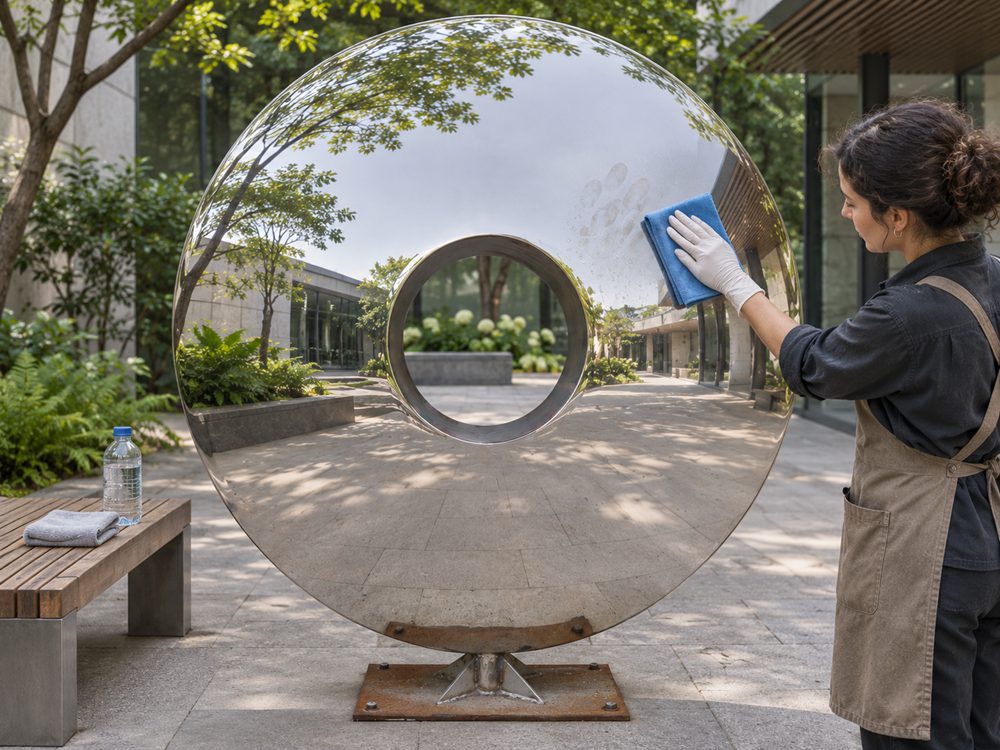
Use a damp, clean microfiber cloth with light pressure. Work in small areas using controlled, straight passes.
Mirror polishing may not have an obvious grain. If the supplier identifies a polishing direction, follow it. Otherwise, I recommend avoiding repeated circular rubbing, which can make any trapped grit leave conspicuous swirl marks.
Turn the cloth frequently to expose a clean section. Replace it as soon as it becomes dirty.
The aim is to lift contamination, not scrub the metal.
Step 4: Remove Soap Residue
Rinse with clean water or wipe with a separate cloth dampened with clean water. Repeat as needed until the detergent is removed.
Pay attention to folds, recesses, and the area around the base, where dirty water can collect. Do not flood inaccessible cavities.
Where water is hard, I prefer a distilled or deionized final rinse when practical. These types of water contain fewer dissolved minerals that can remain after evaporation.4
Step 5: Dry and Finish the Surface
Dry promptly with a fresh microfiber cloth. Blot remaining droplets first, then use light passes to remove moisture.
Inspect the surface from different angles. If a mark remains, identify it before repeating the cleaning process. A mineral deposit, grease film, and scratch need different responses.
I would not use metal polish as a routine finishing step. Many polishing products contain abrasives and can change the appearance of a mirror finish.5 Repairing scratches is a specialist task, not ordinary cleaning.
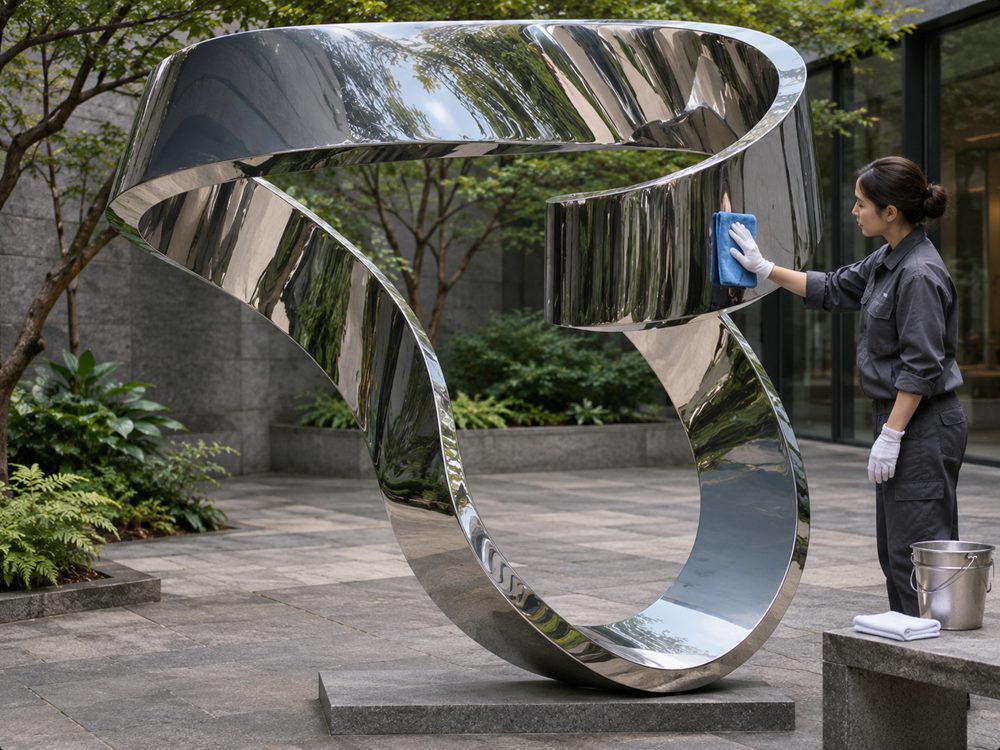
What Should You Never Use on a Mirror-Polished Stainless Steel Sculpture?
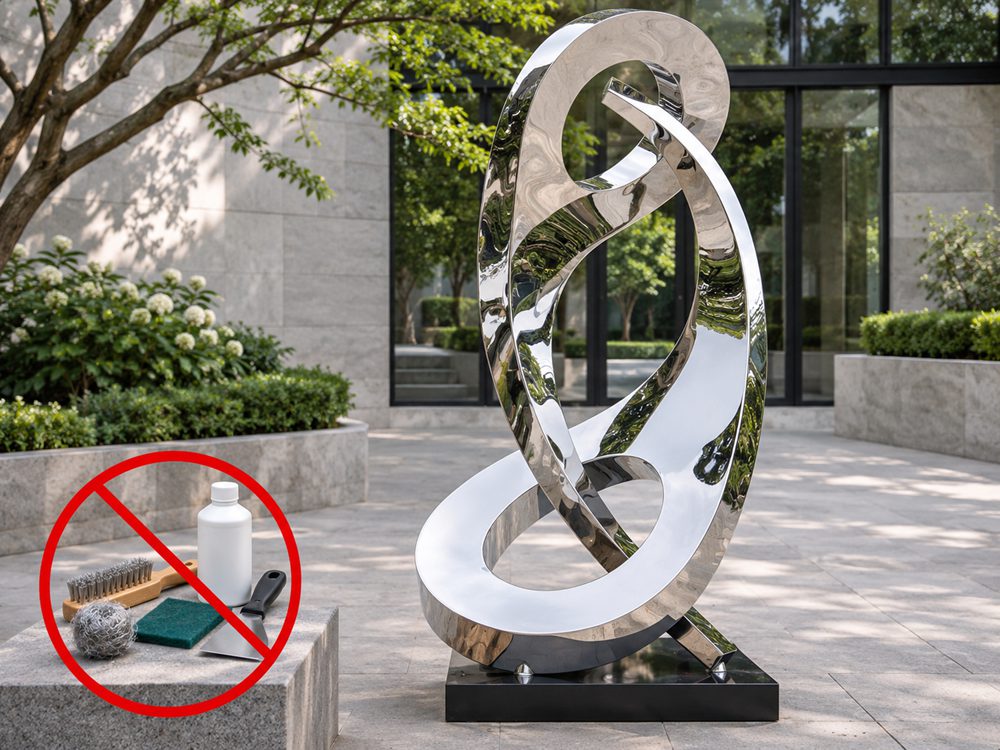
I treat the following as unsuitable for routine cleaning unless the sculpture manufacturer has specifically approved a controlled application.
| Product or Method | Main Risk |
|---|---|
| Steel wool or wire brushes | Scratching and possible iron contamination |
| Abrasive pads, powders, or cream cleansers | Fine scratches and loss of reflection clarity |
| Scouring sponges | Abrasive surfaces can mark the finish |
| Chlorine bleach and hydrochloric-acid cleaners | Corrosion risk |
| Unapproved acidic descalers | Damage to the metal, coating, or nearby materials |
| Unapproved solvents | Damage to coatings, sealants, adhesives, or painted details |
| Dirty cloths or dry wiping over grit | Scratches from trapped particles |
| Razor blades or metal scrapers | Gouges and visible scratches |
| Aggressive pressure washing | Damage to seals or water entry into vulnerable areas |
| Unapproved metal polish or polishing machines | Uneven gloss or altered surface geometry |
My practical rule is simple: if a product removes dirt by grinding, scraping, or aggressive chemical action, it is not my first choice for a mirror-polished sculpture.
Paper towels are also not my preferred option. Their softness varies, and trapped particles remain a risk.
How to Remove Different Stains Without Scratching the Surface
I always start with the mild cleaning method above. Stronger treatment should follow identification of the stain and confirmation that the product is compatible with the finish.
Removing Fingerprints and Handprints
Fingerprints usually consist of skin oils and moisture. A lightly dampened microfiber cloth may remove fresh marks; a mild detergent solution is useful when oil remains.
Rinse and dry afterward. Do not keep buffing a dry fingerprint with increasing pressure.
For a publicly accessible sculpture, I would focus on regular gentle cleaning rather than attempting to keep the surface permanently fingerprint-free.
Removing Water Spots and Mineral Deposits
Fresh water spots may come off with a damp cloth followed by drying. Established mineral deposits can require a different treatment.
I would first confirm that the mark is a deposit rather than corrosion, coating damage, or a scratch. If mild washing does not remove it, ask the supplier for an approved mineral-deposit remover and its application instructions.
Do not assume that vinegar or a household limescale remover is safe for every sculpture. Compatibility depends on the finish, nearby stone, joints, and other materials.
Test any approved treatment in a hidden area and rinse thoroughly. Prevent recurrence by removing the water source where possible, such as irrigation spray.
Removing Grease and Oil Stains
Use a mild detergent solution and allow brief contact time without letting it dry. Lift the loosened grease with a clean cloth, then rinse.
If grease remains, I recommend requesting a finish-compatible degreaser rather than choosing a strong solvent independently.
Adhesive residue and protective-film marks deserve the same caution. Their removal may require a product approved for the specific coating or metal surface.
Removing Bird Droppings and Outdoor Dirt
Bird droppings should be removed promptly, but never scraped off while dry.
Wear suitable gloves, wet the deposit, and allow it to soften. Gently lift it away with a wet cloth, then wash, rinse, and dry the area. Replace the contaminated cloth before cleaning another section.
For mud or windblown sand, thorough initial rinsing is especially important. If orange or brown marks persist after washing, I would ask the supplier to assess possible corrosion or iron contamination rather than attempting abrasive removal.
How to Maintain Mirror-Polished Stainless Steel Sculptures Outdoors
I would set the maintenance schedule according to exposure, not use the same interval for every location.
Inspect the sculpture regularly and clean when deposits appear. Record recurring issues so the maintenance method can be adjusted.
| Exposure or Location | Main Concern | Maintenance Priority |
|---|---|---|
| Coastal setting | Salt deposits and corrosion risk | Regular freshwater washing and inspection |
| Near irrigation | Repeated mineral spotting | Redirect spray and remove water deposits |
| Busy pedestrian area | Fingerprints and accidental contact | Gentle cleaning of accessible areas |
| Near construction or roads | Dust, grit, and possible metal contamination | Rinse before wiping |
| Beneath trees or bird activity | Droppings, sap, and organic deposits | Prompt, finish-compatible removal |
| Sheltered recesses | Deposits not washed away by rain | Inspect and clean inaccessible-looking areas |
Rain is not a complete cleaning system. It may leave residue and does not reliably wash sheltered surfaces.6
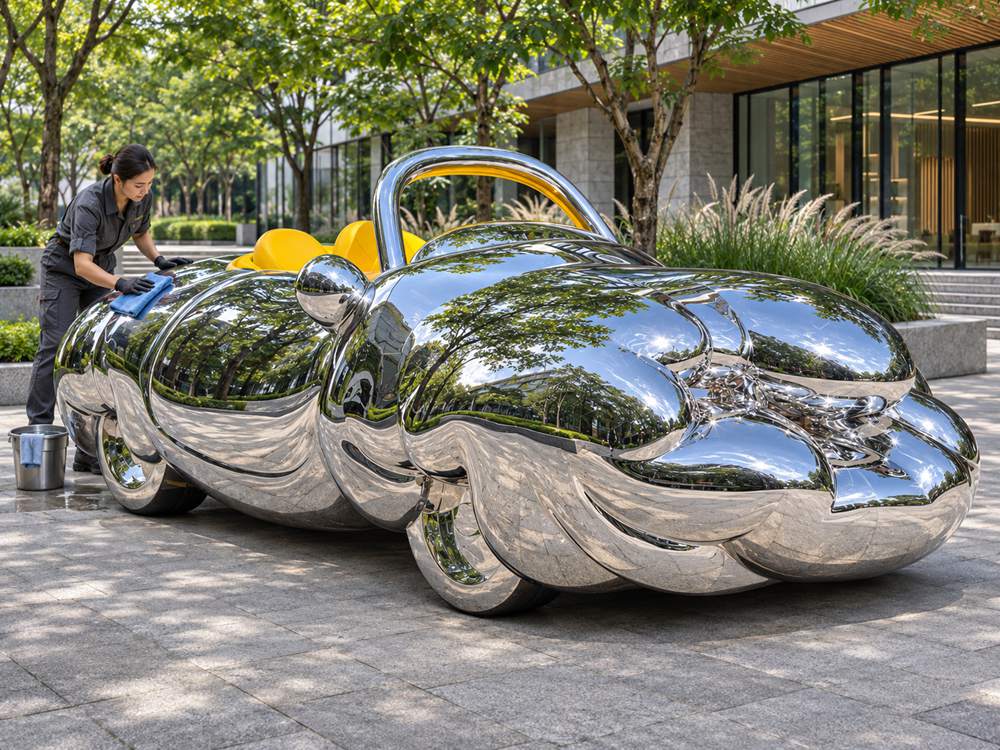
I recommend including these tasks in a maintenance record:
- Inspect seams, fixings, the base, and drainage points.
- Check for recurring stains or changes in reflection.
- Note cleaners used and any unusual surface reaction.
- Photograph persistent marks before treatment.
- Keep maintenance cloths separate from general site-cleaning equipment.
Do not apply wax, oil, or a protective coating without supplier approval. Such products can change the appearance, collect dirt, or complicate future maintenance.
For an existing scratch, stop repeated rubbing. Local polishing can leave a visible patch or distort reflections on a curved surface.7 I would seek specialist assessment before authorizing repair.
How to Select a High-Quality Stainless Steel Sculpture Supplier at the Source
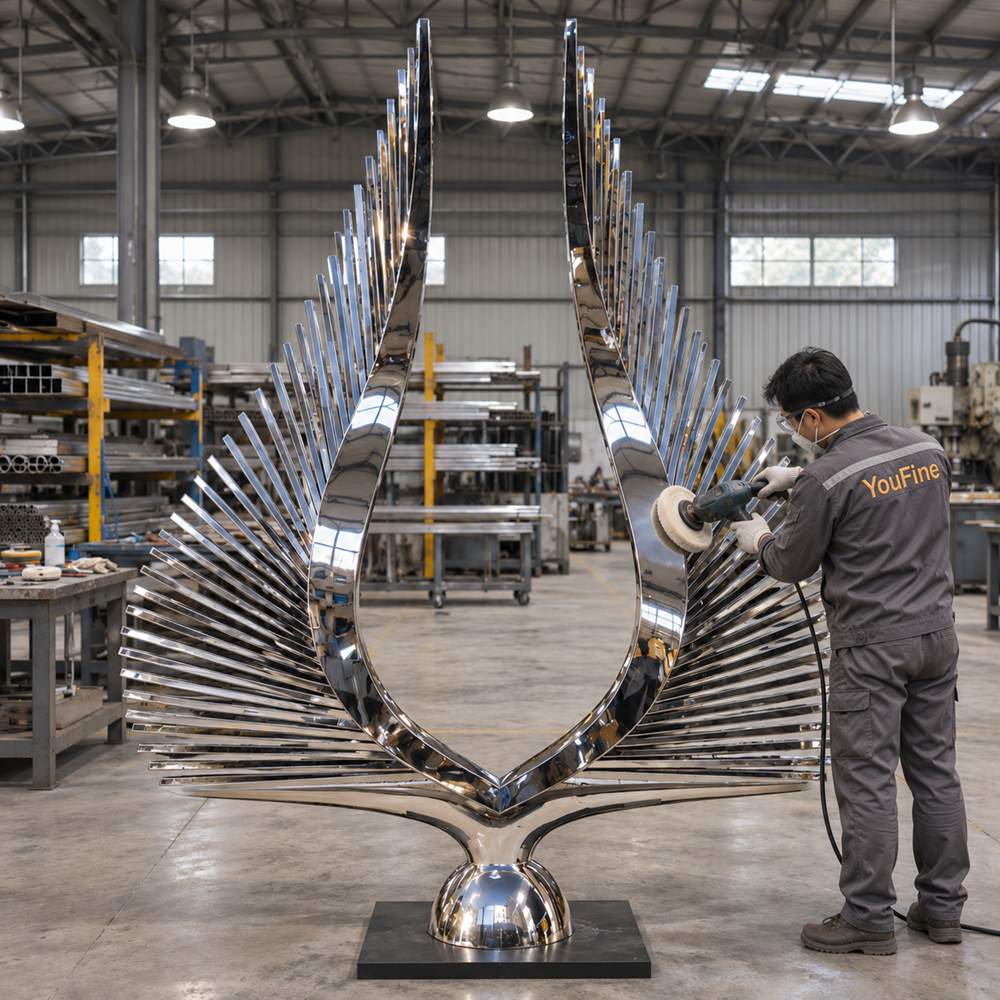
Cleaning cannot compensate for unsuitable material, inconsistent polishing, or details that trap contaminated water.
When discussing a project with YouFine or another stainless steel sculpture supplier, I recommend asking for evidence tied to the actual sculpture—not relying only on attractive finished photographs.
| Supplier Check | What I Would Request | Why It Matters |
|---|---|---|
| Material selection | Stated stainless steel grade and its suitability for the site | Exposure affects material requirements |
| Surface specification | Written confirmation of mirror finish and any coating | Determines cleaning compatibility |
| Polishing quality | Close-up photographs and video under different lighting | Reveals haze, scratches, and uneven reflections |
| Weld finishing | Details of how joints are blended and inspected | Weld areas can interrupt visual continuity |
| Sample approval | A representative finish sample where practical | Establishes an agreed appearance |
| Drainage and access | Drawings showing water management and maintenance access | Helps prevent difficult-to-clean deposits |
| Packing protection | A plan that prevents movement and surface abrasion | Reduces transport damage risk |
| Care documentation | Approved cleaners and repair procedures | Supports safe long-term maintenance |
The grade number alone does not prove overall quality. Fabrication, polishing, contamination control, installation, and maintenance all affect performance.
I would also ask whether the finish sample represents curved surfaces and welded areas, not only a flat, easily polished sheet.
For a You Fine Art Sculpture inquiry, my recommendation is to share the installation environment early: coastal exposure, irrigation, public access, and expected cleaning arrangements. Those details make the material and finish discussion more useful.
In Conclusion: Protect the Reflection Before Removing the Stain
My approach is to start gently and escalate only when the finish and stain are understood. Remove loose particles first, use a mild approved cleaner, rinse completely, and dry with a fresh microfiber cloth.
For long-term care, pay attention to salt, irrigation, trapped water, and recurring contamination. If a mark does not respond to gentle cleaning, stop and seek advice rather than rubbing harder.
If you are considering a mirror-polished sculpture from You Fine Art Sculpture, I recommend sharing your design, installation location, and maintenance conditions before production. Request a finish sample, clear surface specifications, and written care guidance so the sculpture’s appearance and future upkeep are considered together.
FAQs
1. Can I use glass cleaner on a mirror-polished stainless steel sculpture?
I would not assume it is safe. Glass cleaners vary and may contain ingredients unsuitable for coatings or nearby materials. Use it only if the supplier approves the specific product; otherwise, choose a mild, finish-compatible detergent.
2. Should I wipe in circles or straight lines?
I recommend light, straight passes with a clean, damp cloth. Follow any polishing direction identified by the supplier. Removing grit first is more important than the wiping direction alone.
3. How often should I clean an outdoor stainless steel sculpture?
I would base the schedule on inspection and exposure. Salt, bird droppings, irrigation, and construction dust justify more frequent attention than a sheltered, low-contact location.
4. Can cleaning remove scratches from a mirror finish?
No. Cleaning removes contamination, not scratches in the metal. I would have a specialist assess the damage because uncontrolled polishing can create an uneven reflective patch.
5. Is 316 stainless steel maintenance-free outdoors?
No. Grade 316 generally offers better resistance to chloride-related corrosion than grade 304, but it still needs appropriate care.8 I would assess the site exposure and fabrication quality rather than treating a grade designation as a guarantee.
6. What should I do if brown marks remain after washing?
I recommend photographing the marks and contacting the supplier. They may indicate corrosion or iron contamination rather than ordinary dirt. Avoid abrasive pads and unapproved rust removers while the cause is being assessed.
- Cleaning of exterior stainless steel: Trapped grit and abrasive cleaning products can scratch polished stainless steel ↩︎
- Stainless Steel Surface Treatment ↩︎
- Corrosion properties: Stainless steel corrosion resistance depends on a protective passive oxide layer ↩︎
- Canadian Conservation Institute distilled deionized water cleaning dissolved minerals residues ↩︎
- Mirror, Profiles and Coloured Surfaces: Abrasive polishing products may alter an existing mirror-polished finish. ↩︎
- Care and Maintenance of Stainless Steel: Rainfall does not adequately clean sheltered stainless steel surfaces. ↩︎
- How to Polish Stainless Steel to a Mirror Finish: Localized polishing repairs can produce visible finish differences or distort reflected images. ↩︎
- Corrosion Resistance in Marine Environments: Grade 316 has greater chloride corrosion resistance than grade 304 but is not maintenance-free. ↩︎