
Roman columns have defined architectural beauty and structural elegance for more than two thousand years. From grand public buildings to private villas and garden landscapes, these classical elements remain a timeless choice in modern design.
Whether you are designing a luxury home, restoring a historical structure, or planning a decorative outdoor space, understanding the different types of Roman marble columns will help you make the right decision.
At YouFine, we have decades of experience crafting custom marble columns for clients worldwide. In this guide, we will walk you through the five main types of Roman columns and how to choose the best one for your project.
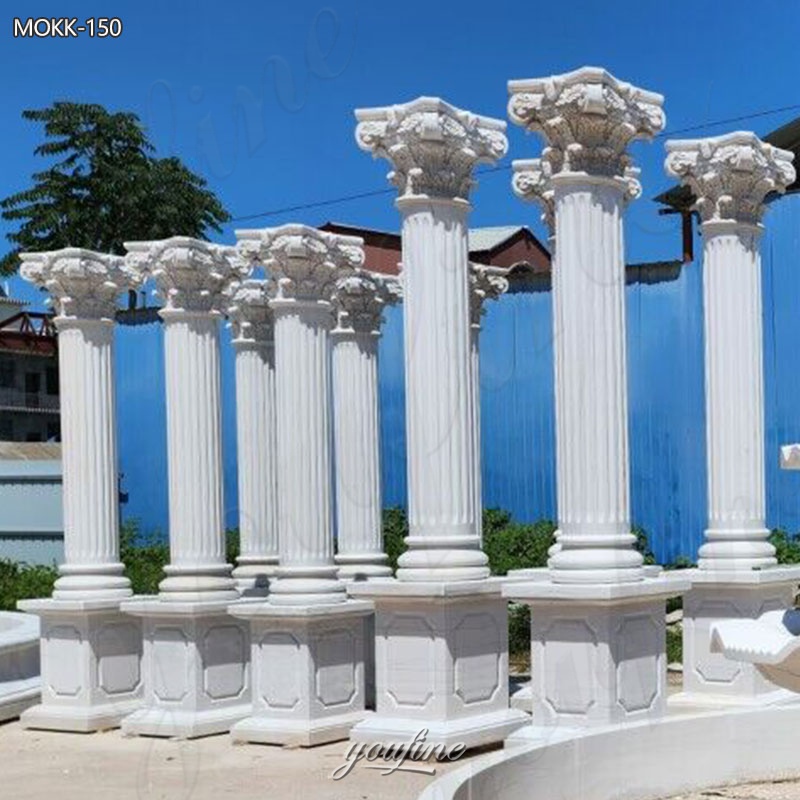
What Are Roman Columns?
Roman columns are vertical structural elements inspired by ancient Greek architecture but further developed by the Romans to be more decorative and versatile.
They are closely related to the classical system known as the Greek Orders, which defines the proportions, details, and decorative styles of columns.
While the Greeks focused on strict proportions and simplicity, the Romans introduced more elaborate designs and combined different styles to create new variations. This innovation made Roman columns widely adaptable for both structural and ornamental purposes.

Overview of the 5 Types of Roman Columns
There are five primary types of Roman columns, each with its own characteristics and level of decoration:
Column Type | Origin | Key Feature | Decorative Level |
Tuscan | Roman | Simple, smooth shaft | Low |
Doric | Greek | Strong, minimal design | Low |
Ionic | Greek | Scroll-shaped capital | Medium |
Corinthian | Greek | Acanthus leaf decoration | High |
Composite | Roman | Mixed Ionic & Corinthian | Very High |

1. Tuscan Order Column
The Tuscan column is the simplest of all Roman column types. It features a smooth shaft, a plain capital, and a solid base with minimal ornamentation.
This style reflects strength and practicality rather than decoration.
Best for:
- Modern villas
- Garden structures
- Pergolas and outdoor marble gazebos
At YouFine, Tuscan columns are often chosen by clients who prefer a clean and minimalist architectural style while maintaining a classical touch.

2. Doric Order Column
The Doric Order is one of the oldest and most recognizable column styles. It is known for its sturdy proportions and simple design.
Doric columns typically have a fluted shaft and a plain capital, emphasizing strength and stability.
Best for:
- Government buildings
- Memorials
- Institutional architecture
This type is ideal for projects that aim to convey power, durability, and tradition.

3. Ionic Order Column
The Ionic Order is more elegant and refined compared to the Doric style.
Its most distinctive feature is the spiral scrolls, known as volutes, on the capital.
Best for:
- Courtyards
- Libraries
- Decorative facades
Ionic columns are a popular choice for residential projects where a balance between simplicity and decoration is desired.

4. Corinthian Order Column
The Corinthian Order is the most ornate and luxurious of the classical column styles.
Its capital is richly decorated with acanthus leaves and intricate carvings, requiring a high level of craftsmanship.
Best for:
- Luxury villas
- Hotels
- High-end architectural projects
At YouFine, Corinthian columns are among the most requested styles due to their elegant appearance and impressive visual impact. Our craftsmen carefully carve each detail to ensure artistic precision and durability.

5. Composite Order Column
The Composite column is a Roman innovation that combines elements of the Ionic and Corinthian styles.
It features the volutes of the Ionic order along with the rich leaf decorations of the Corinthian order, resulting in a highly decorative and sophisticated design.
Best for:
- Grand entrances
- Luxury commercial buildings
- Landmark projects
This style is often used to create a strong visual statement and convey prestige.

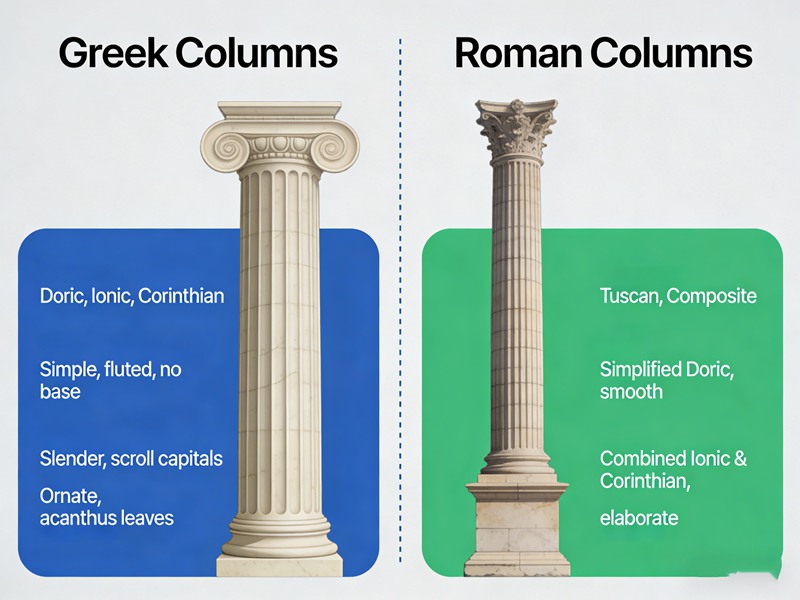
Roman Columns vs Greek Columns
Although Roman columns originated from Greek architecture, there are key differences between the two:
Feature | Greek Columns | Roman Columns |
Design Style | Simpler and stricter | More decorative |
Usage | Mainly temples | Widely used in various structures |
Innovation | Limited variation | Includes new styles like Composite |
Roman architecture expanded the possibilities of column design, making them more suitable for modern applications.
How to Choose the Right Column for Your Project
Selecting the right column depends on your design goals, budget, and application.
Here are some practical recommendations:
- For small gardens or outdoor spaces: Tuscan or Ionic columns
- For luxury villas: Corinthian or Composite columns
- For public or monumental buildings: Doric columns
At YouFine, we provide customized solutions based on your architectural drawings, including size, material, and design details to ensure perfect integration with your project.

Conclusion
Roman columns continue to be a fundamental element in architecture, offering both structural support and artistic beauty.
From the simplicity of Tuscan columns to the richness of Corinthian and Composite styles, each type serves a unique purpose and aesthetic.
Choosing the right column not only enhances the appearance of your project but also reflects its character and value.
If you are looking for custom marble columns, YouFine offers professional design support, high-quality craftsmanship, and worldwide shipping.