From my 20-plus years of helping clients find the right sculpture solution, I have learned that an Atlas statue is one of the most misunderstood purchases in the high-end landscape market.
Buyers often fall in love with the image—a powerful figure bearing the weight of the world—but then struggle to translate that image into a statue that actually works on their property. The figure looks commanding in a reference photo, yet ends up feeling oversized in a courtyard, too small at a grand entrance, or stylistically out of place beside a contemporary façade.
Over the years, I have worked through Atlas projects for villas, estates, hotels, and resort landscapes across many different climates and architectural styles. What I have found, consistently, is that the customers who get the best results are the ones who start with the setting—not the statue.
This guide is designed to help you think through that process before you make an inquiry.
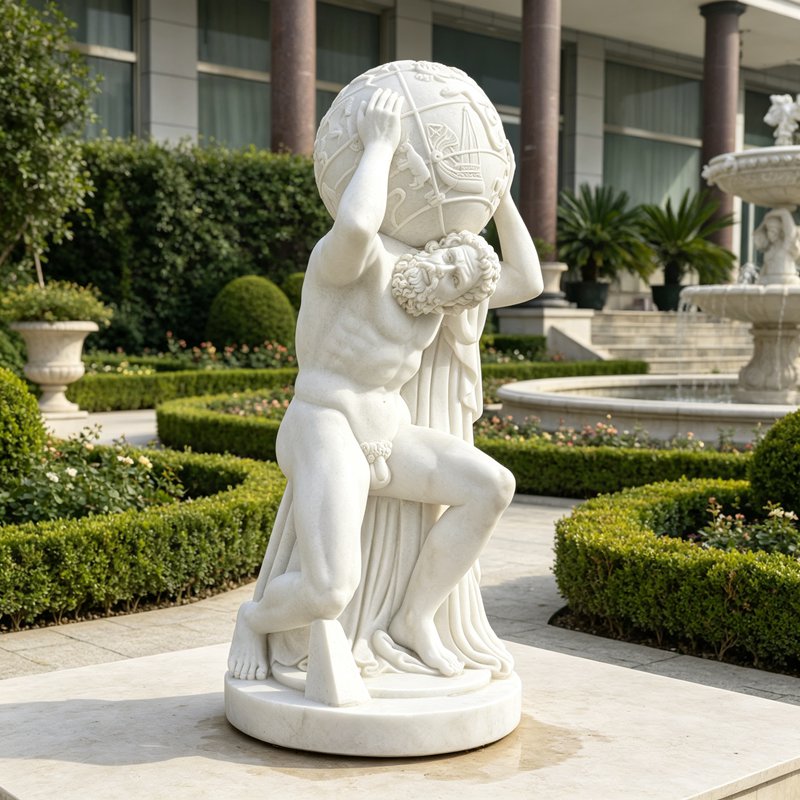
Who Is Atlas? A Brief Mythology Summary for Buyers
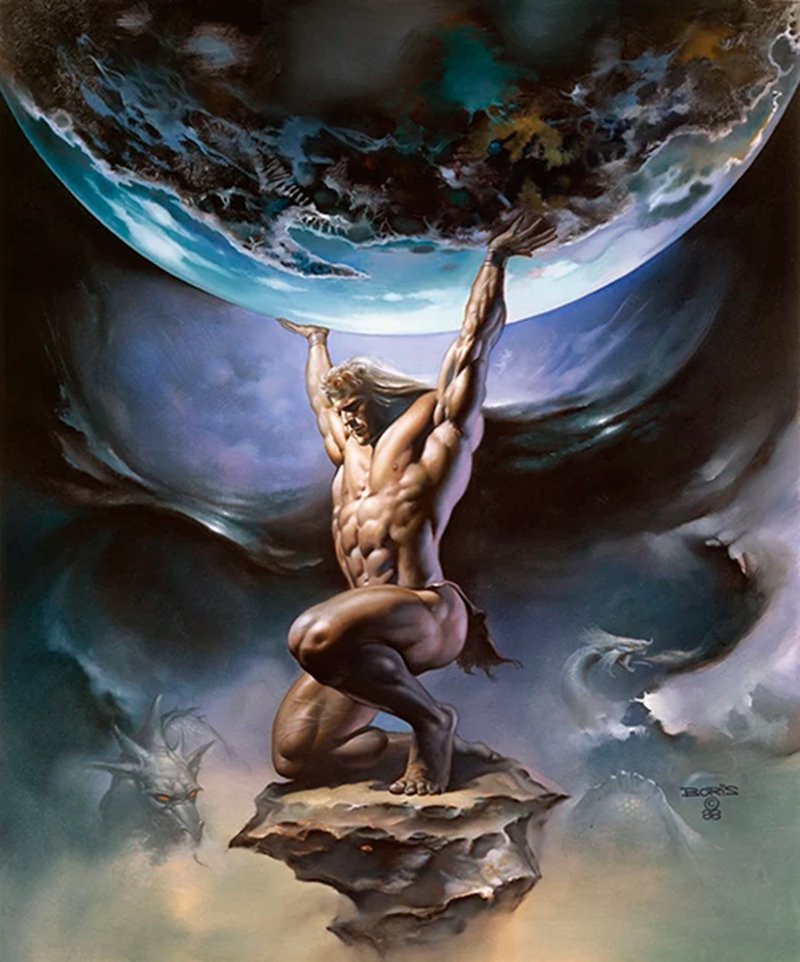
Atlas is a Titan from Greek mythology, condemned by Zeus to hold up the sky—or, in later artistic tradition, the celestial globe—for eternity. He represents endurance, burden, and immovable strength. Unlike many mythological figures associated with beauty or grace, Atlas is defined by effort and responsibility. His posture is always one of sustained tension: bent knees, braced back, arms raised, muscles under load.
That symbolic weight is exactly why property owners and project designers choose him. An Atlas statue communicates something specific: that this place is built on strength, that it carries something of value, that it endures. For a villa entrance, a hotel lobby courtyard, or a resort plaza, that message can be very powerful when the execution is right.
Keep the mythology brief in your own thinking. What matters for your project is how that meaning translates into form, scale, and placement.
Where Does an Atlas Statue Work Well?
An Atlas statue is not a general-purpose garden ornament. It works best where the setting supports its scale, its posture, and its symbolic weight. Here are the placement contexts I see most often in successful projects:
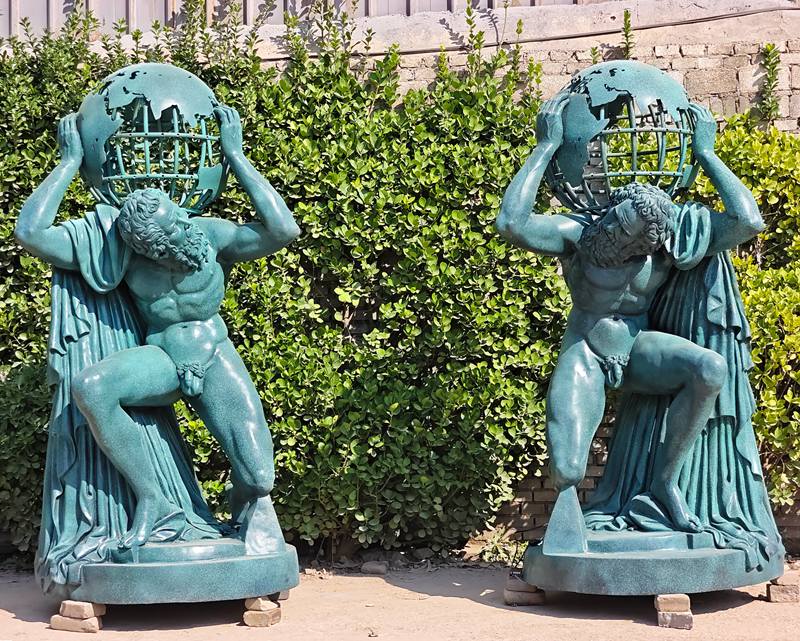
- Grand entrances and gateposts — A pair of Atlas figures flanking a driveway entrance creates a strong classical statement. The figures should be proportional to the gate width and the building height visible from the road.
- Courtyard focal points — A single Atlas statue placed on a central axis draws the eye and anchors the space. The courtyard dimensions determine whether the figure should stand alone or be integrated with a water feature or plinth.
- Pool landscapes and terrace areas — Atlas works well near water when the globe or load element reflects light. The surrounding hardscape and planting scale must support the statue’s mass.
- Façade niches and architectural supports — In classical European architecture, Atlas figures (called Atlantes or Telamons) are used as load-bearing decorative columns. This is a structural and aesthetic choice that requires close coordination with the architect.
- Resort plazas and hotel arrival areas — A large-scale Atlas in a resort setting becomes a landmark. Viewing distance here is typically longer, which changes the size and detail requirements significantly.
If your intended placement is not on this list, that does not mean Atlas is wrong for your project. It means you should think carefully about whether the symbolic and visual weight of the figure suits the atmosphere you are creating.
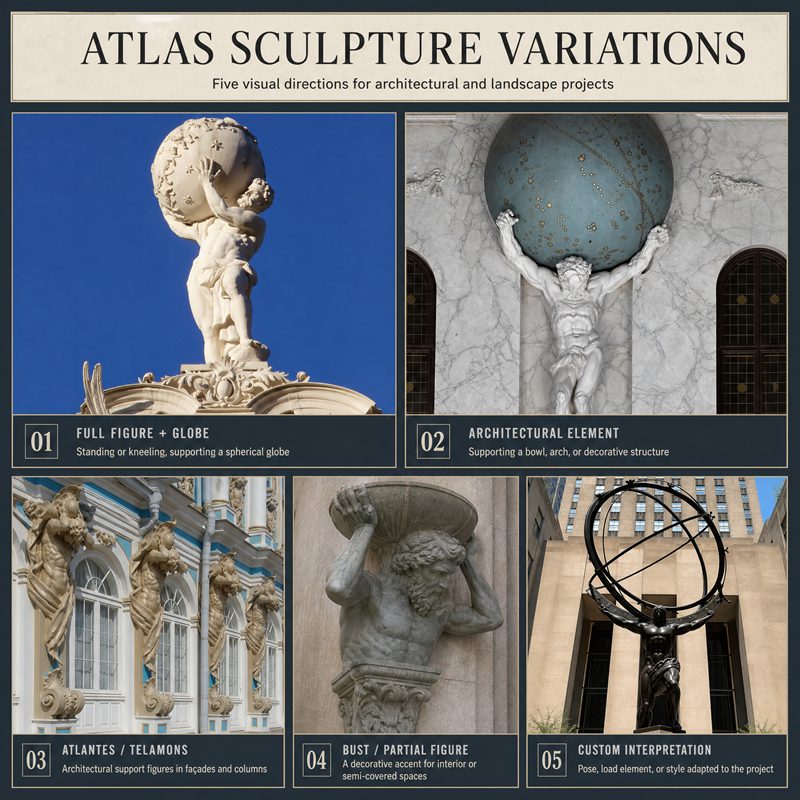
Common Types of Atlas Statues
Understanding the main types helps you narrow down your reference images and communicate more clearly during the inquiry process.
| Type | Description | Typical Use |
|---|---|---|
| Full figure with globe | Atlas kneeling or standing, supporting a spherical globe on his shoulders | Garden focal point, entrance, courtyard |
| Full figure with architectural element | Atlas supporting a bowl, arch, or decorative structure | Custom architectural integration |
| Atlantes / Telamons | Architectural support figures built into columns or pilasters | Façade decoration, structural ornament |
| Bust or partial figure | Upper body of Atlas, often used as a decorative accent | Smaller spaces, interior or semi-covered areas |
| Custom interpretation | Pose, load element, or style adapted to the project | Bespoke villa or resort commissions |
The full figure with globe is the most commonly requested type for outdoor landscape projects. The globe proportion relative to the figure is one of the most important design decisions—too small and the figure looks unloaded; too large and the composition becomes top-heavy.
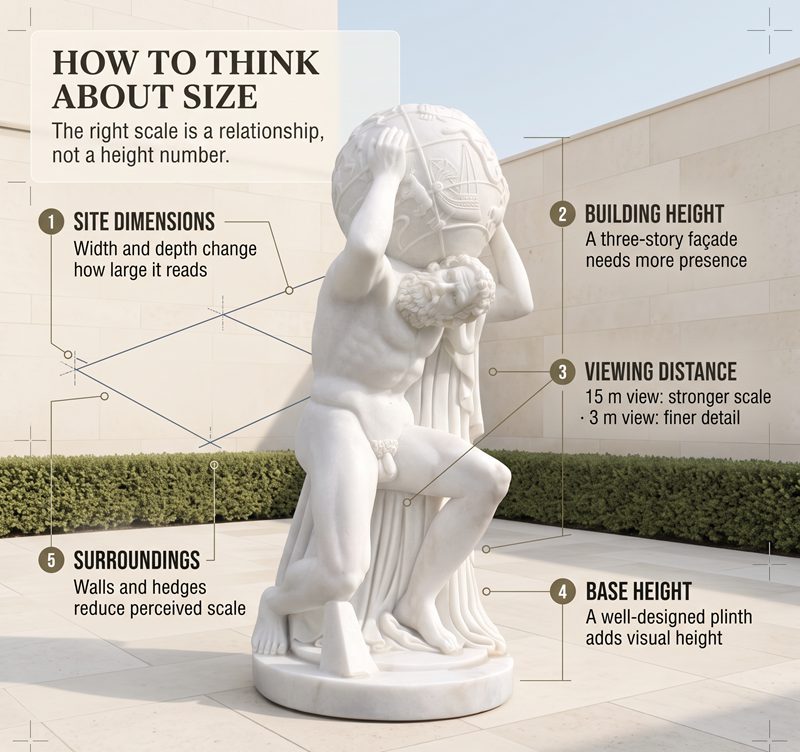
How to Think About Size
This is where most buyers make their first mistake: they look at a height number and assume it tells them everything. It does not.
The right size for an Atlas statue depends on several factors working together:
- Site dimensions — The width and depth of the space around the statue affect how large or small it reads visually.
- Building height — A statue placed against a three-story façade needs more height than the same statue placed in an open garden.
- Viewing distance — If most viewers will see the statue from 15 meters away, the figure needs enough scale to read clearly at that distance. If the primary viewing distance is 3 meters, a smaller figure with finer detail may be more appropriate.
- Base height — A well-designed plinth (the raised base the statue stands on) can add significant visual height without increasing the statue’s actual dimensions. Many clients underestimate this.
- Surrounding plants and walls — Tall hedges or walls behind a statue can make it appear smaller than it is. Open sky behind the same statue makes it appear larger.
A practical approach: photograph your site from the primary viewing angle, note the dimensions of the space, and share both with your supplier. This gives a professional team enough information to recommend a size range rather than guessing from a catalog number.
Material Selection: Matching, Not Ranking
I do not recommend one material for every Atlas statue project. The best choice depends on the desired appearance, installation environment, budget, and whether you want the Atlas figure and the celestial sphere to create a contrasting visual effect.
Here is a practical comparison:
| Material | Visual Effect | Outdoor Durability | Detail Capacity | Weight | Maintenance |
|---|---|---|---|---|---|
| Bronze | Rich, timeless appearance with a natural patina that develops over time | Excellent for most outdoor environments | Very high; ideal for detailed anatomy, muscles, and facial features | Heavy; requires a stable base and secure installation | Occasional cleaning and waxing; patina can be maintained or allowed to age naturally |
| Marble | Classical, elegant, and architectural; natural stone veining gives each piece a unique character | Excellent in suitable climates; sealing may be recommended in wet or freeze-thaw conditions | High; excellent for classical carving and refined details | Very heavy; requires a strong foundation and careful transportation | Periodic cleaning; sealing may be recommended depending on climate |
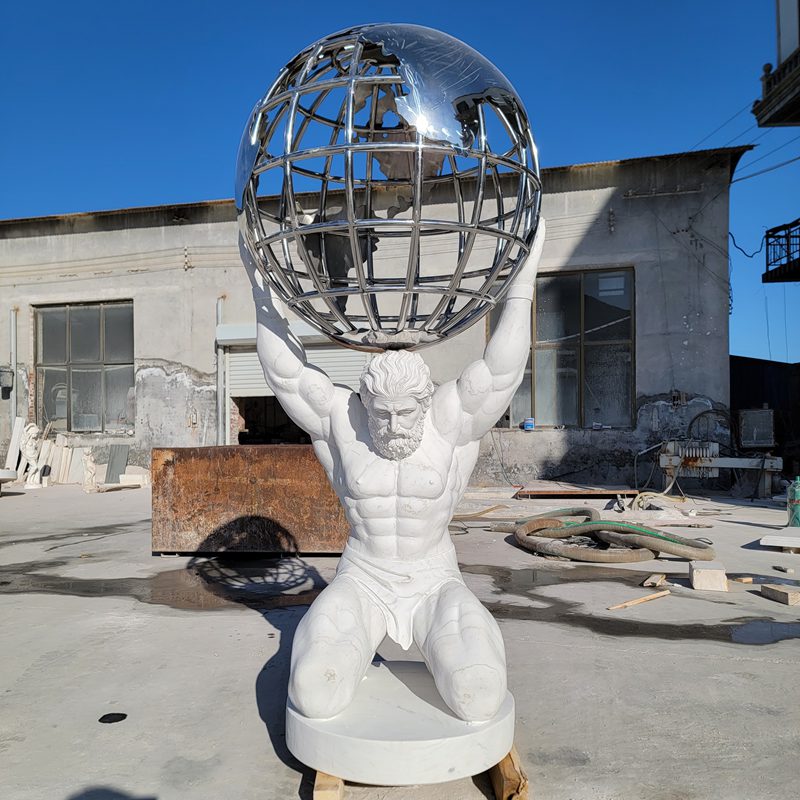
| Combined Materials | Creates a striking contrast—for example, a marble Atlas with a bronze or stainless steel sphere | Depends on the materials used; both can perform well outdoors when properly finished | Combines the sculptural qualities of carved marble with the clean or reflective appearance of metal | Heavy because of the marble body, although the sphere can be comparatively lighter | Maintenance varies by material; marble and metal should be cared for according to their respective finishes |
| Resin | Smooth, versatile, and suitable for painted, stone-like, or bronze-look finishes | Suitable for many outdoor applications when formulated and coated for exterior use | Good for reproducing complex sculptural details; mold quality is important | Much lighter than marble or bronze; easier to transport and install | Periodic cleaning and inspection of the protective coating; refinishing may be needed over time |
For a classical and monumental Atlas statue, marble is an excellent choice, especially when the sculpture is intended for a luxury estate, hotel, garden, or traditionally styled architectural setting. Bronze provides a stronger sense of permanence and character, while its natural patina can become part of the sculpture’s visual appeal.
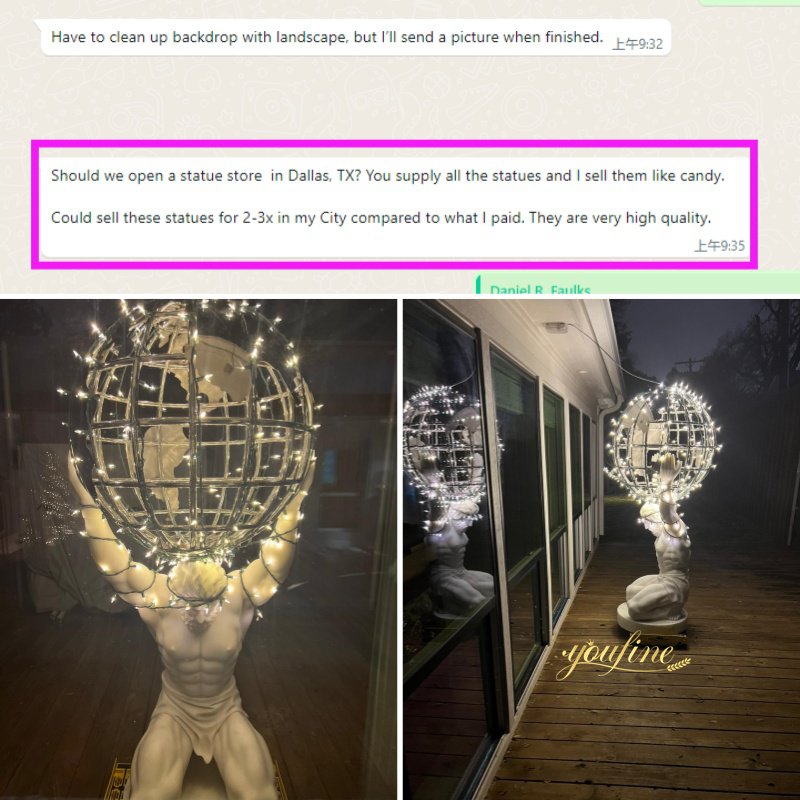
A combined-material Atlas can create an especially distinctive appearance. For example, the Atlas figure can be carved from natural marble, while the sphere above his shoulders is made from bronze or mirror-polished stainless steel. The marble provides the classical character of the figure, while the metal sphere creates a clear visual focal point and contemporary contrast. Stainless steel can also introduce a brighter, more modern and reflective appearance than bronze.
Resin is worth considering when weight, transportation, installation, or budget is a major concern. With an appropriate exterior-grade formulation and protective coating, resin can reproduce the appearance and details of a more expensive sculpture while making installation considerably easier.
The right material is ultimately the one that fits your project—not simply the most expensive option. For custom Atlas statues, the material, sphere finish, size, installation method, and surrounding architecture can all be coordinated to achieve the intended visual effect.
Craftsmanship: What to Look For in an Atlas Statue
An Atlas statue lives or dies on a small number of specific details. When reviewing supplier samples or production photos, focus on these areas:
- Facial expression — Atlas should show effort and endurance, not blankness or theatrical pain. The brow, jaw, and eye area should communicate sustained strain without looking cartoonish.
- Shoulder and back tension — The trapezius and deltoid muscles (the large muscles across the upper back and shoulders) should show clear tension under load. Flat or soft modeling here makes the figure look unconvincing.
- Muscle structure — The abdomen, arms, and legs should show anatomically coherent muscle groups under strain. This requires a sculptor with strong figurative anatomy knowledge, not just decorative carving skill.
- Posture and balance — The figure’s center of gravity should feel stable. A poorly balanced pose looks like the figure is about to fall rather than bearing a load.
- Globe or load proportion — As mentioned earlier, the globe size relative to the figure is a critical composition decision. Review this in the 3D model or clay model stage before production begins.
- Base integration — The transition from the figure’s feet to the plinth should look intentional, not like the figure was simply placed on top of a block.
Why “Similar Photos” Are Not Enough
This is a point I want to be direct about. Buyers often send a reference image and assume that any supplier who produces a similar-looking statue will deliver an equivalent result. That assumption is risky.
Two Atlas statues can look nearly identical in a small photograph and be very different in person. The differences show up in:
- The quality of facial expression at close viewing distance
- The depth and accuracy of muscle modeling
- The surface finish consistency across the full figure
- The proportion accuracy when the statue is seen at full scale
- The structural integrity of the globe or load element
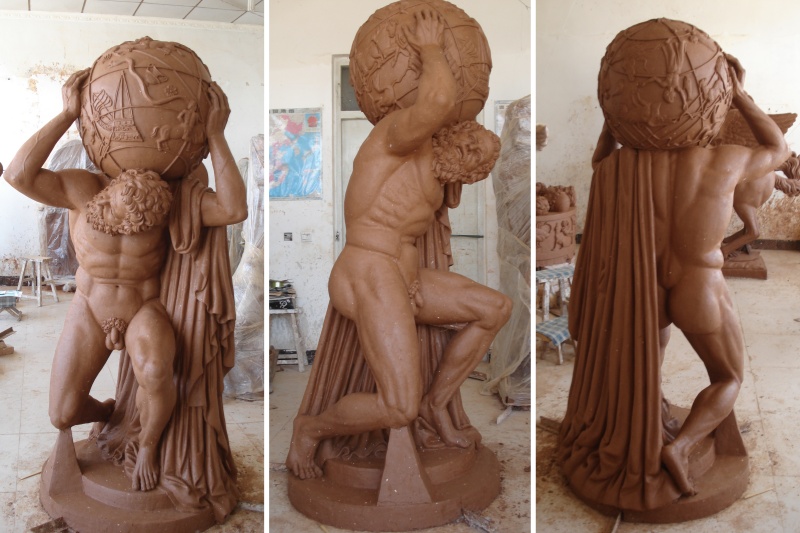
A professional supplier should be able to show you production-process photos—clay model stages, carving-in-progress images, surface finishing steps—not just finished product photos. These process records are evidence that the team can control quality at each stage, not just present a polished final image.
At You Fine Art Sculpture, the production team documents each stage of a custom Atlas project, from initial 3D modeling through clay model review to final surface finishing. This gives clients a checkpoint system rather than a single reveal at the end.
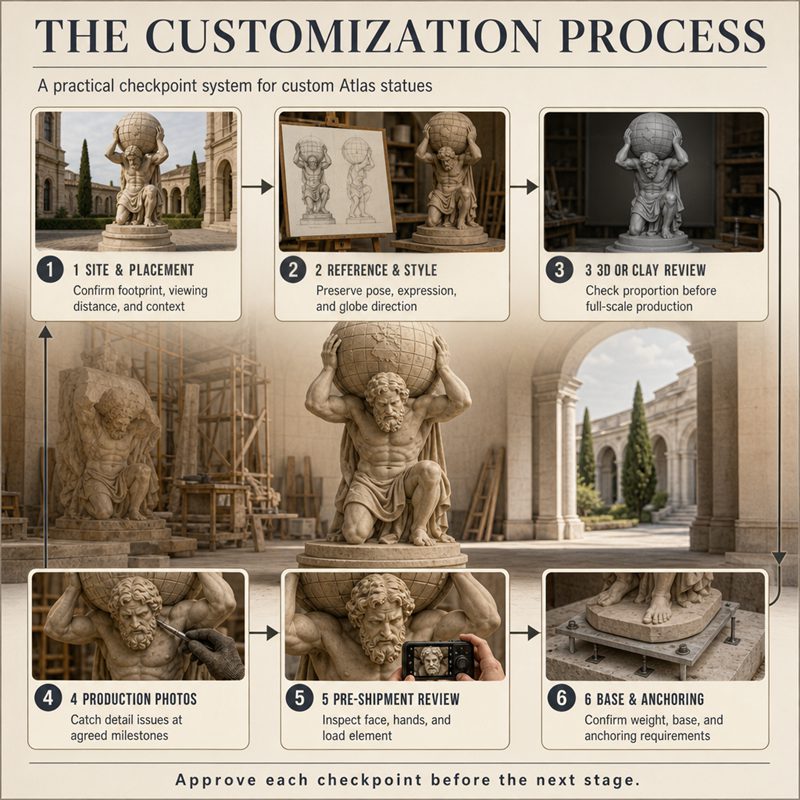
The Customization Process: A Practical Checkpoint System
For a custom Atlas statue, a structured process reduces the risk of receiving something that looks wrong on site. Here is the sequence I recommend:
1. Confirm site dimensions and placement — Before any design work begins, establish the exact location, the available footprint, the viewing distances, and the surrounding architectural context.
2. Confirm reference images and style direction — Provide multiple reference images if possible. Note which elements you want to preserve (pose, expression, globe type) and which you are flexible on (surface finish, base style, minor proportional adjustments).
3. Review a 3D model or clay model — This is the most important checkpoint. A 3D rendering or a small-scale clay model allows you to evaluate proportion, pose, and expression before any full-scale production begins. Changes at this stage are manageable; changes after full-scale carving or casting are costly and time-consuming.
4. Approve production-stage photos — During carving or casting, request progress photos at agreed milestones. This allows you to catch proportion or detail issues early.
5. Review pre-shipment photos — Before the statue leaves the workshop, review detailed photos of the finished piece from multiple angles, including close-ups of the face, hands, and load element.
6. Confirm installation base and anchoring — Ensure the installation team has the statue’s weight, base dimensions, and anchoring requirements before the piece arrives on site.
Summary: Start with the Setting
An Atlas Greek mythology statue can be one of the most powerful focal points on a high-end property—when the scale, material, expression, and placement are right. When they are not, the same figure can feel out of place, unconvincing, or simply too large or too small for the space it occupies.
The decision process that works best is straightforward: start with your site, not the statue. Understand the dimensions, the viewing distances, the architectural style, and the atmosphere you want to create. Then move to size, material, pose, and detailing.
Use a model review stage to confirm proportion and expression before full-scale production begins. And prepare a thorough inquiry so your supplier can give you accurate recommendations rather than generic catalog options.
FAQs
1. How tall should an Atlas statue be for a villa entrance?
There is no single correct height, but a useful starting point is to consider the gate or entrance width and the building height visible from the road. For a standard villa entrance, figures between 150 cm and 250 cm (including the base) are common. For a grand estate entrance with a wide driveway and a tall façade, larger figures may be appropriate. I always recommend sharing site photos and dimensions before settling on a height, because the same 180 cm figure can look very different depending on what surrounds it.
2. Is marble or bronze better for an outdoor Atlas statue?
Neither is universally better. Marble suits classical European architectural styles and performs well in stable, temperate climates. Bronze handles a wider range of outdoor conditions and captures fine muscle and facial detail very well through casting. The right choice depends on your climate, your architectural style, your maintenance capacity, and the visual effect you want. If you are in a region with significant freeze-thaw cycles or high humidity, discuss this with your supplier before choosing marble.
3. Can I use a reference image from the internet to order a custom Atlas statue?
Yes, reference images are a useful starting point, but they are not a production specification. A professional supplier will use your reference image to understand your style direction, then develop a 3D model or clay model for your review and approval before production begins. The model stage is where proportion, expression, and globe size are confirmed. Skipping this step and going directly from a reference photo to finished production significantly increases the risk of a result that does not match your expectations.
4. What information should I prepare before contacting a supplier?
Before making an inquiry, try to gather: the intended placement location and its dimensions, the primary viewing distance, the architectural style of the surrounding buildings, your preferred material, your approximate size range, reference images showing the style and pose you prefer, and any landscape or architectural drawings available. The more context you provide, the more accurate the supplier’s recommendations and quotation will be.
5. How long does a custom Atlas statue typically take to produce?
Production time varies depending on material, size, and complexity. A marble Atlas statue requires hand-carving, which is time-intensive. A bronze piece requires mold-making, casting, and patina finishing. Fiberglass can be faster if a suitable mold exists. For a fully custom piece, allow time for the model review and approval stage before production begins. A reliable supplier will give you a realistic timeline at the quotation stage, including model review, production, finishing, and shipping.
6. How do I evaluate whether a supplier can deliver the craftsmanship quality I need?
Ask for production-process documentation, not just finished product photos. A supplier who can show clay model stages, carving-in-progress images, and surface finishing steps is demonstrating process control, not just a polished final result. Also look for completed installation examples with photos taken on site, and ask whether the supplier has handled projects of similar scale and material. Customer feedback and completed case records are more reliable indicators than catalog images alone.